The Heir and the Debutante
In attempting to tell the story of John and Madeleine Astor, I found that there is so much information out there, an article cannot contain all known details of their lives. As a result, this article will focus on the brief intersection of their lives as well as their time on Titanic and the aftermath that followed. For more information, I encourage you to continue to deep dive into these fascinating and prominent figures in Titanic lore. I would like to thank Daniel Klistorner, David Nonini, Brian Hawley, and Boris Mileski for their help with this article.
At 10:00 A.M. on the morning of April 16, 1912, 21-year-old Vincent Astor was accompanied by his father’s secretary W.A. Dobbyn and a legal representative of the family, A.J. Drexel Biddle as they made their way through a crowd of people outside the White Star Line office in New York City. Little information had reached them about the Titanic disaster through the wireless telegraph, but they had started intercepting the names of those on board for the families of confirmed survivors, though the list was not 100% accurate. The White Star Line offices kept an evolving tentative list to try and provide information to some of those connected to the passengers and crew of the Titanic. For Vincent, his father, John Jacob Astor IV, and step-mother, Madeleine Force Astor, were two of the most prominent passengers on the Titanic which made it more probable to get some answers. Vincent, Dobbyn, and Biddle walked up the concrete stairs into the White Star Line office with onlookers watching, hoping for news of their own loved ones. The trio were quickly shown into the office of P.A.S. Franklin, the Vice-President of the White Star Line and head of the company’s American operations, where he invited them in and shut the door. After some time, Vincent walked out weeping. Though details were not yet known fully about what took place in the sinking, Madeleine’s name was known to be on the list of survivors and his father’s was not. Vincent was helped into his automobile by Dobbyn and Biddle and they drove away. There was still hope that his father was among the survivors, but that hope was dwindling.
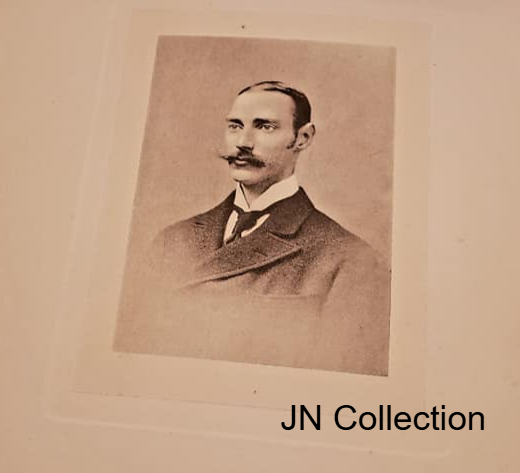
John Jacob Astor IV
Author's Collection
Scion of the Astor Legacy
John “Jack” Jacob Astor IV was born on July 13, 1864 to William Backhouse Astor Jr. and Caroline Astor in the Astor mansion in Rhinebeck, New York. He was a direct descendant of John Jacob Astor I, who was America’s first millionaire and the family quickly established themselves as the first American dynasty of the super-wealthy. Astor IV grew up in the lap of luxury with his every want or need cared for. His father was a noted yachtsman and real estate developer. His mother established herself as THE Mrs. Astor with her husband, and led the “Four Hundred” which was a group of New York society’s cream of the crop, largely coming from old money and established families. John was the youngest of 5 children, but he was the only male amongst his siblings. He was educated at St. Paul’s in Concord, N.H. and Harvard University. He was an inventor, author, and businessman. His interests ranged from real estate and hotels to science fiction. He founded or was a major investor in the Astoria Hotel (later the Waldorf-Astoria), the Plaza Hotel, and the Regis Hotel. John’s interest in science fiction led to him writing a novel called “A Journey in Other Worlds.” John had several patents including for a marine turbine engine, a bicycle brake, and a pneumatic road improver which he exhibited and received attention for at the Chicago World’s Fair. In addition, he liked to invest in other inventors who would produce things that would help mankind such as Nikola Tesla.
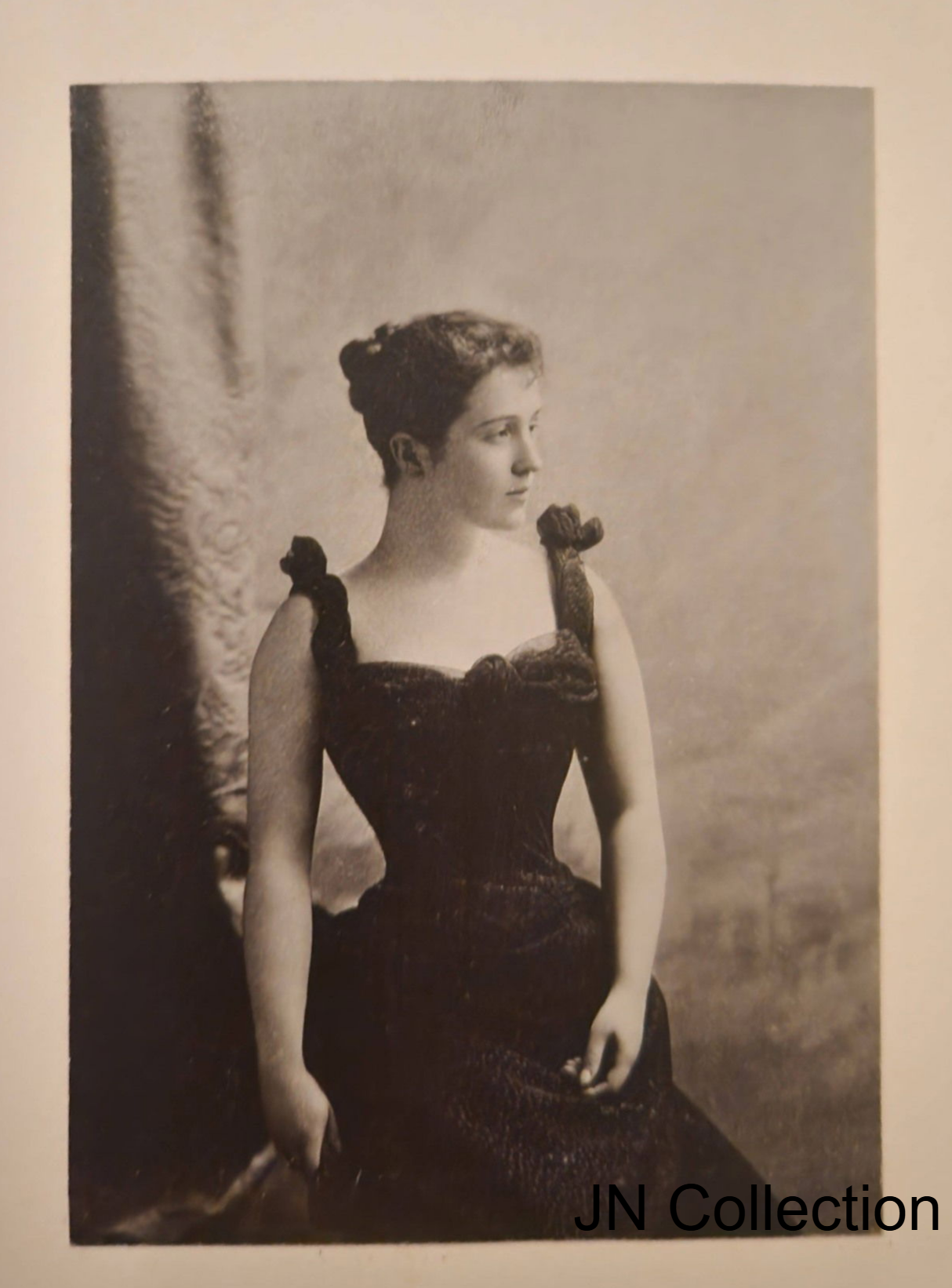
Ava Alice Astor
Author's Collection
On February 17, 1891, he married Ava Lowle Willing. Ava also came from a long established wealthy and influential family which seemed to be a great match on paper. However, it was not a love-match in actuality. A year after John and Ava married, his father passed away with the bulk of his estate going to John and smaller portions going to his widow and daughters to ensure they wanted for nothing. John and Ava had two children named William Vincent (born in 1891) and Ava Alice Muriel (born in 1902).
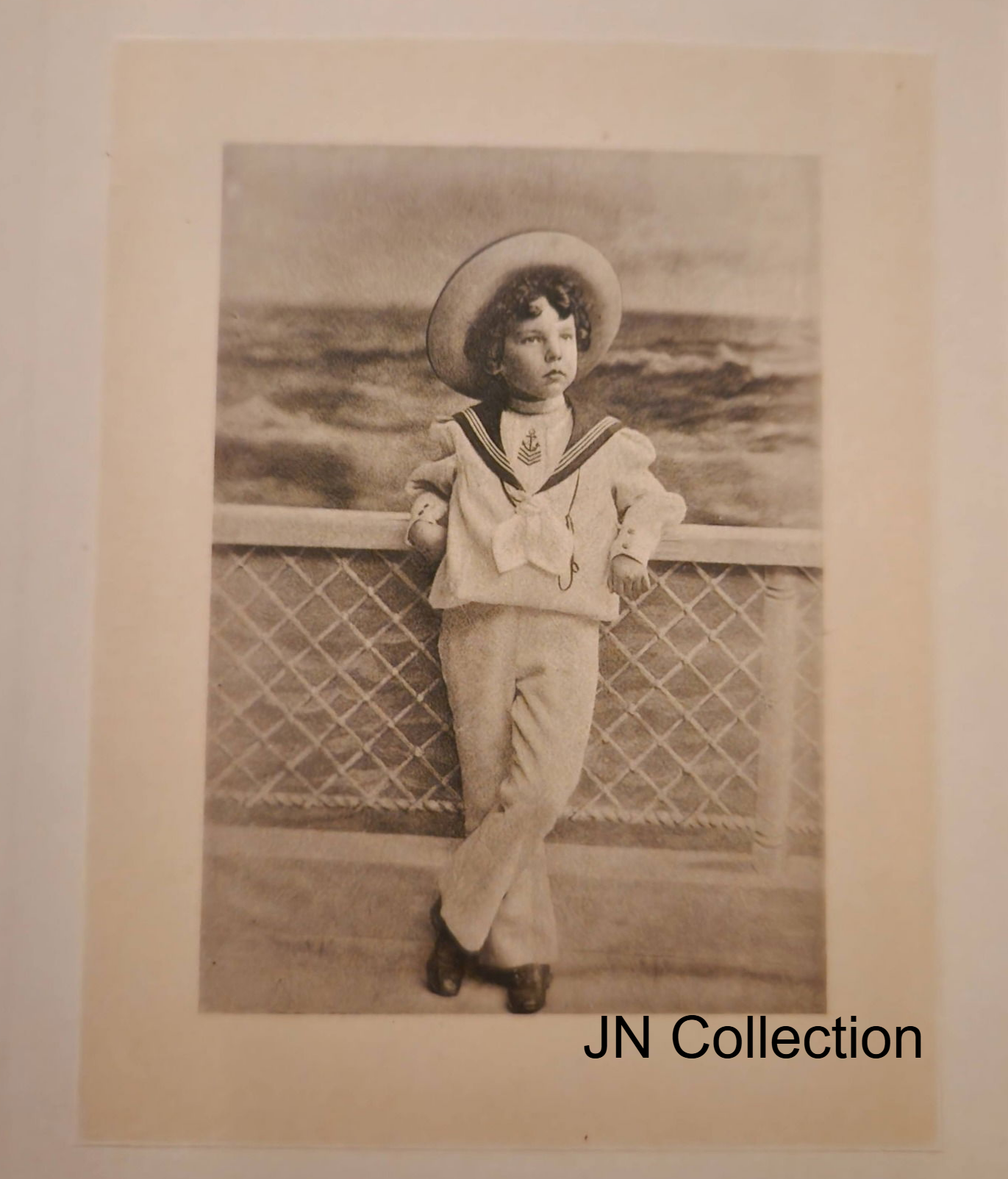
Vincent Astor as a boy.
Author's Collection
Because divorce was less of an option for John and Ava, they followed the example of John’s parents who were also not a love match. John spent more time on his yachts and with his business ventures while Ava kept up appearances in New York society which resembled the dynamics of his own parents. He was also a member of more than 40 clubs largely in the New York area.
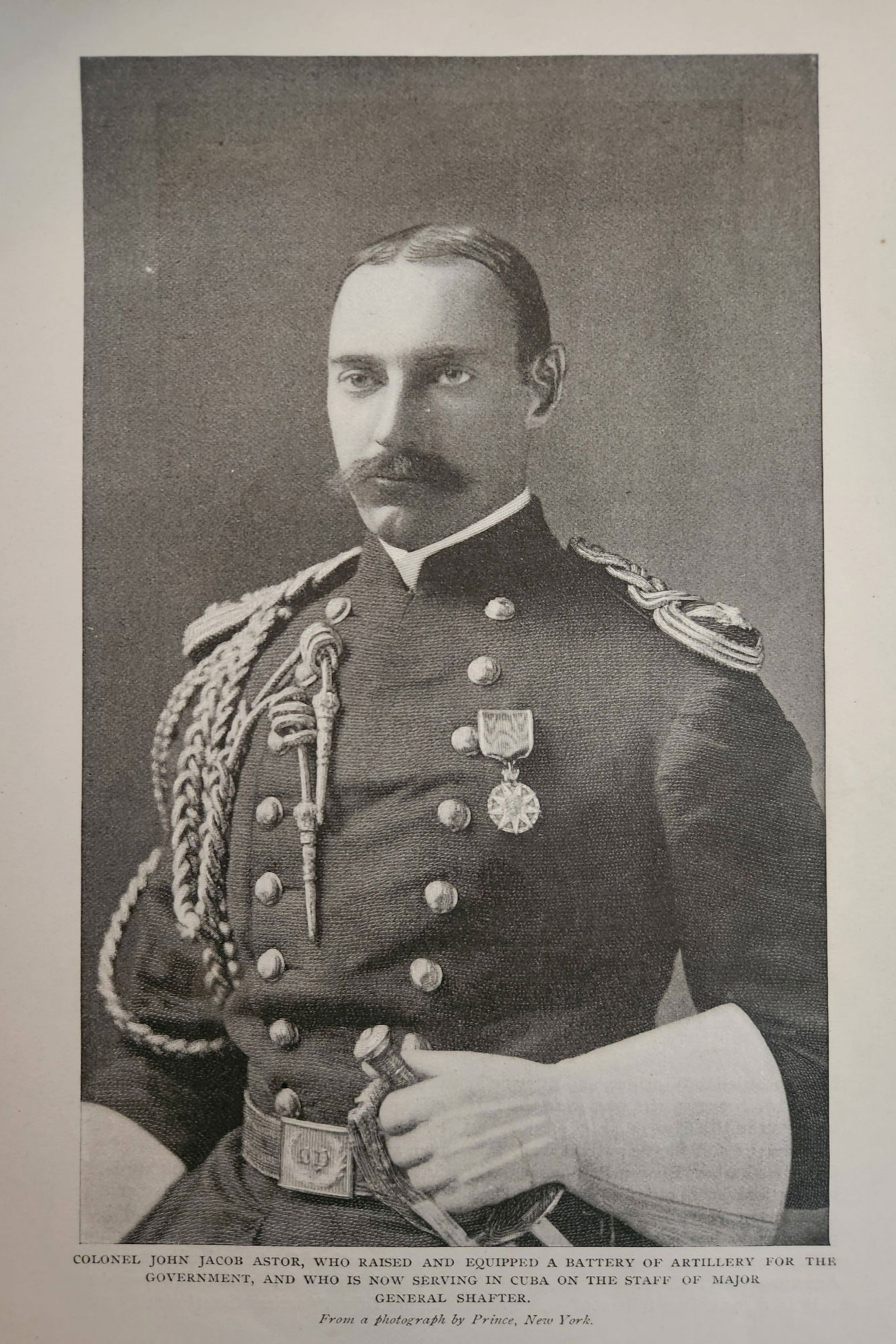
Col. John Jacob Astor IV in his unform in 1898.
Author's Collection
John gained the rank of Colonel when he served on the staff of New York governor (and former Vice President) Levi P. Morton during the Spanish-American War. He was promoted to Lieutenant Colonel in the U.S. volunteers and worked on organizational/logistical aspects of the military. He offered his yacht Normahal for the US government to use during the war and outfitted a mountain battery of artillery. They served in Santiago and the Philippines, though he never commanded troops in a conflict. For the rest of his life, he was known as Colonel Astor and remained proud of his service.
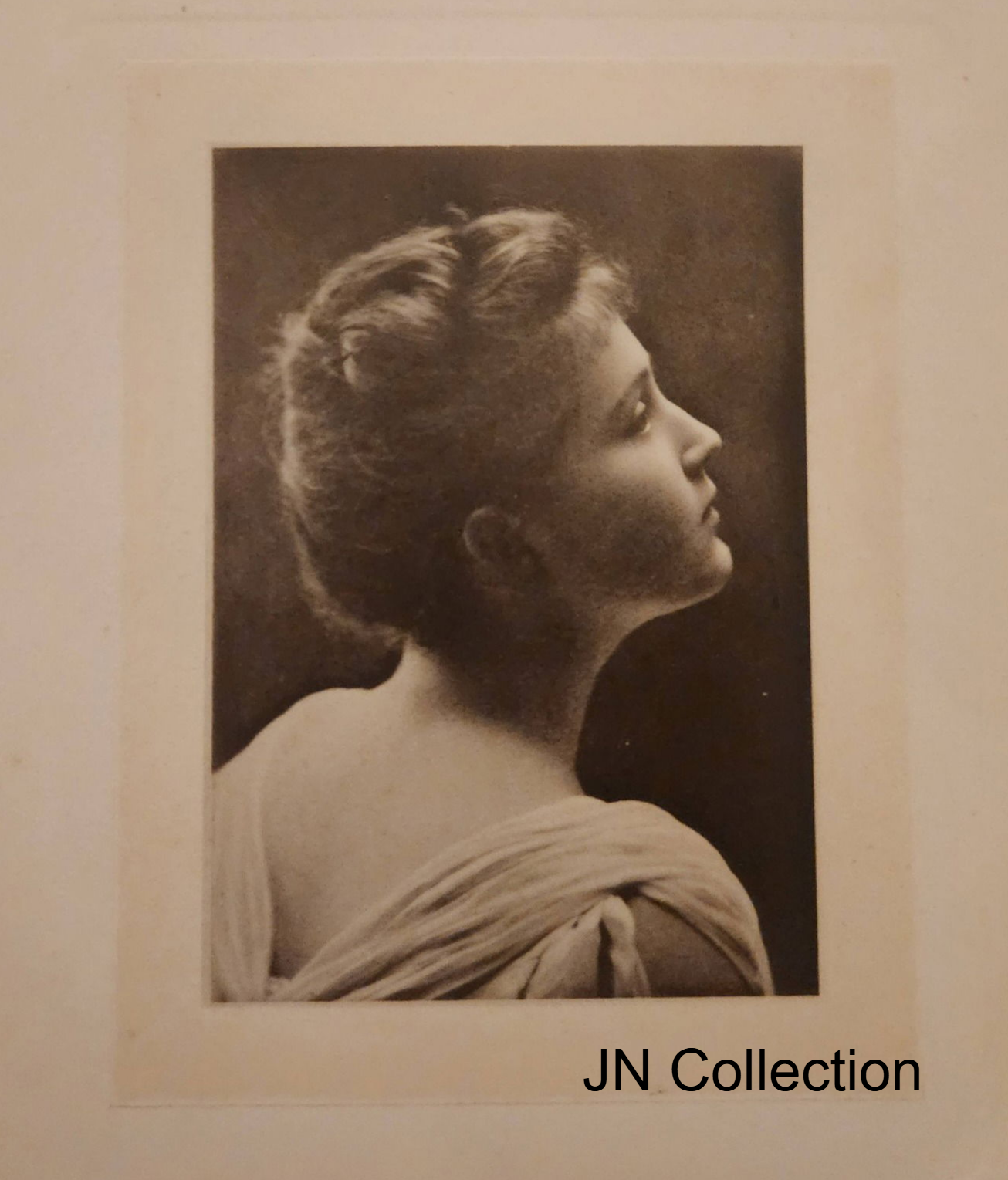
Ava Alice Astor
Author's Collection
In 1909, John and Ava’s marriage had been brought to the brink where the two decided to go their separate ways. The divorce was decreed with the money being privately agreed upon prior to the divorce decree. The judge also ruled that John would have custody of Vincent with Ava being able to see him when she liked, while Muriel would remain with Ava and her father would see her whenever it was reasonable. Divorce at that time was not as common or socially accepted as it is today and those who were divorced risked becoming social pariahs. That divorce rocked New York’s high society and scandalized both of them. Especially given how his late mother Caroline was adamantly against divorce. She had dealt with some scandal in her own time as her daughter (and John’s sister) Carrie divorced her husband James Drayton in 1896. This divorce sent shockwaves through society prior to John and Ava and Caroline did throw a party with other divorced women in an attempt to bring her daughter out from being shunned, but she still adamantly opposed it until her death. She went as far as to talk her own niece into returning to her abusive husband to protect the family’s “good standing” and she herself endured a marriage in which her husband conducted numerous affairs, but did not divorce. It is reasonable to assume that had she been alive, things would have been worse for both of them.
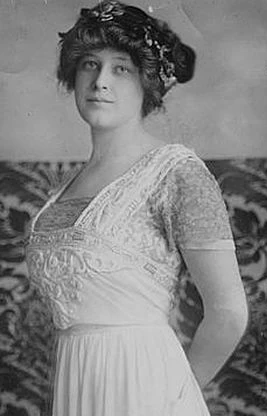
Madeleine Talmage Force
Library of Congress
Introducing Madeleine
In the summer of 1910, Colonel Astor met a 17 year old Madeleine Force in Bar Harbor, Maine. The daughter of William H Force (who was a successful businessman) and Katherine Talmadge, Madeleine was a tall girl with brown hair with strong, clean-cut features. She had been educated at Miss Spence’s School which was a boarding school for girls and spent much time abroad in France. She and Colonel Astor began courting despite their 29 year age difference soon after that meeting and were frequently seen together. In August 1911, their engagement was announced. Following their engagement, there was much talk and controversy over Colonel Astor’s 2nd choice in a bride. They had a hard time finding a minister to officiate the ceremony, despite Colonel Astor’s heavy involvement in a church in Rhinebeck due to his status as a divorcee. The wedding took place in the ballroom of Colonel Astor’s Newport mansion officiated by Rev. Joseph Lambert, a Congregationalist minister. There were not very many guests, but her parents did attend. Vincent Astor was the best man and Madeleine’s older sister Katherine was the maid of honor. The ceremony and subsequent reception were short. Following their wedding, the newlyweds were photographed out and about in New York numerous times. The unusualness of their marriage drew much attention from the press, society, and the general public. Reverend Lambert was even called “worse than Judas” by a fellow minister for officiating the ceremony and later forced to resign from his pulpit.
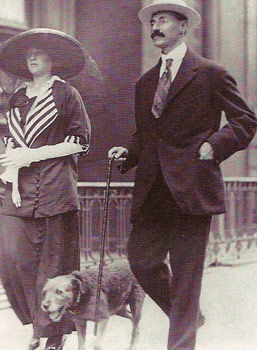
John, Madeleine, and their dog Kitty
Public Domain
A Honeymoon To Remember
The couple decided to leave on a long honeymoon in the hopes that the attention would lessen during their absence. They booked passage in January 1912 on the RMS Olympic, twin sister ship to the upcoming RMS Titanic. They were joined by some staff which consisted of Colonel Astor’s valet Victor Robins who had been working for Colonel Astor since at least 1909, Madeleine’s maid Rosalie Bidois, and Madeleine’s nurse Caroline Endres. By this point, they likely knew that Madeleine was pregnant and Endres was brought to help Madeleine with her pregnancy.
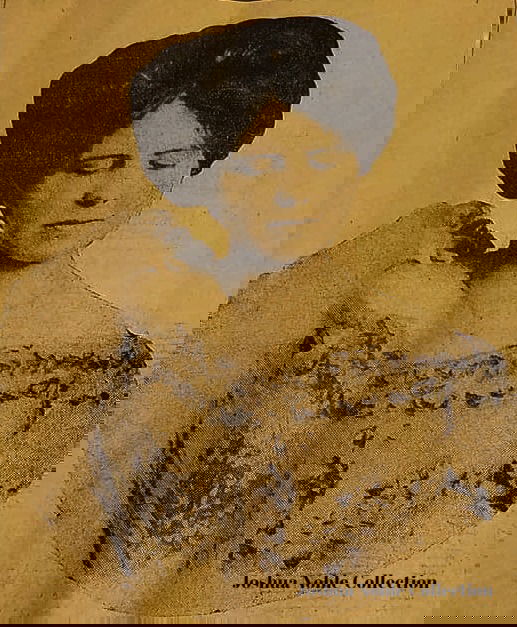
Madeleine's maid Rosalie Bidois
Author's Collection/New York Press
While on board, they encountered people including J. Bruce Ismay, Margaret Brown, and Captain Smith who would later be on their Titanic voyage. The Astors toured North Africa and Egypt with Margaret Brown joining them for part of that trip as well. Margaret Brown (now more commonly known as the Unsinkable Molly Brown) was what they called “new money,” not from an established family from “The 400.” However, Margaret was known as one who was not as judgmental or stuck-up, something the Astors might have greatly appreciated. At one point during a cruise down the Nile, Colonel Astor’s Airedale dog named Kitty got lost. The Astors were distraught over the dog’s loss, especially since Kitty was Colonel Astor’s constant companion ever since he had gotten her. All of a sudden, Kitty appeared on a different boat passing their boat! Kitty saw her owners and jumped to their boat, being reunited with them joyfully. Then they went up to Naples, Rome, and Paris.
On Board the RMS Titanic
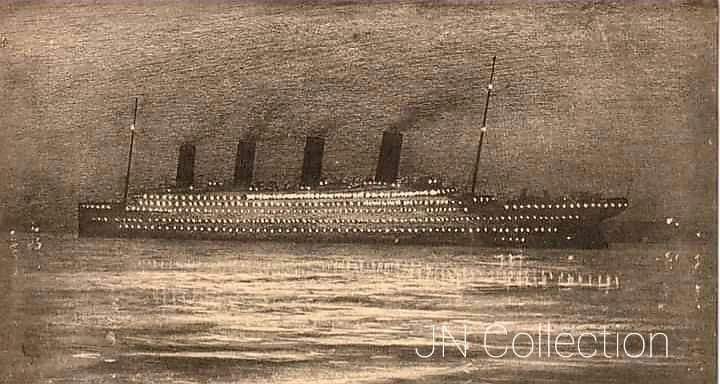
Titanic in Cherbourg
Author's Collection
On the late afternoon/early evening of April 10, 1912, the Astors boarded the SS Nomadic at Cherbourg. The Nomadic was a tender built by the White Star Line to transport 1st and 2nd class passengers out to the waiting ocean liner. Cherbourg’s port couldn’t accommodate ships bigger than a certain amount, necessitating the tenders. The Titanic was an hour late to Cherbourg due to her near collision with the SS New York in Southampton. While they were on board, fellow passenger Edith Rosenbaum sat next to them on the Nomadic, shivering from the cold. She observed the Astors playing with their dog while Colonel Astor touted how much it cost to build the Titanic as well as how unsinkable she was to her. When the Titanic arrived, the Nomadic was brought to her side where they boarded with their servants, dog, and luggage. After they boarded the ship, they went to their stateroom. They had their own room while nurse Endres, Bidois, and Robbins had cabins nearby.
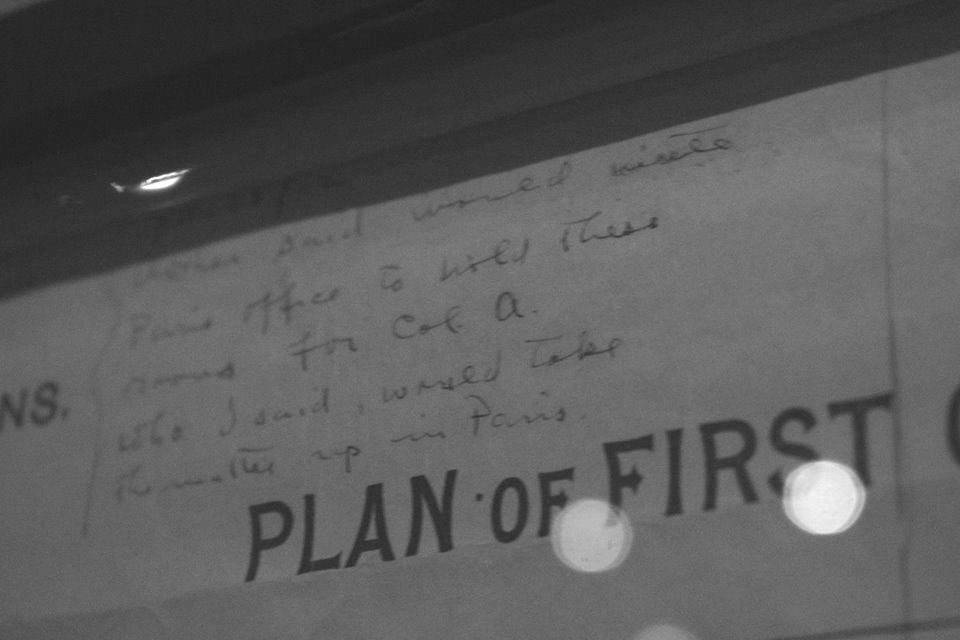
Mr. Dobbyn's notes on the Astor plan about reserving cabins on the Titanic for "Col. A."
Author's Photography/Ronald Reagan Presidential Library
The Astors’ cabin location has been a bit of a mystery. There were cabins marked for them on a deck plan by Astor’s personal secretary Mr. Dobbyn. He marked C-74 and C-76 as their cabins on a deck plan. However, one of those cabins is believed to have been stayed in by other passengers which makes it highly unlikely that they actually were in those cabins. It is worth noting that fellow passenger Helen Bishop said, “Because the Astor’s stateroom was close to ours, we had considerable to do with them and I disliked to leave them on deck.” Helen and Dickinson Bishop occupied either B-47 or B-49, though it is also worth noting that Bishops had a forward standard cabin and the Astors paid too much for their cabin to have stayed in a standard cabin like the Bishops. It should also be noted that one of the Carpathia passengers named Mary Birkhead said that a woman from Wisconsin told her she was alerted to something happening by Mrs. Astor crying in the passageway. The most likely woman from Wisconsin was Lilian or Daisy Minahan who were located amidships on C-Deck near where the Astors originally booked which would put them in a C-Deck cabin near the middle of the ship. John Jacob Astor IV was the wealthiest man on board and was well known by their fellow passengers, especially people of New York and Philadelphia societies which included illustrious names known by thousands at the time. Even those who were not in the top tier societies were aware of these members of “American royalty” on the passenger list. Their recent scandal did not dampen their popularity. Not everyone was impressed with them, however. Stewardess Violet Jessop spoke of illusions of famous people being shattered by the press when she met them prior to saying,
“So it was not surprising when John Jacob Astor brought his bride of a year on board, about whom there had been so much publicity. Instead of the radiant woman of my imagination, one who had succeeded in overcoming much opposition and marrying the man she wanted, I saw a quiet, pale, sad-faced, in fact dull young woman arrive listlessly on the arm of her husband, apparently indifferent to everything around her. It struck me for the first time that all the wealth in the world did not make for inward contentment.”-Titanic Survivor by Violet Jessop
1st class passenger May Futrelle said, “Someone had pointed out the Astors to us. Of course I, with every other woman on board, was curious about them. His height and her smart little figure would have made them noticeable in any circumstances. She was wearing a pretty ermine cap, and we used to spot it all over the ship, for they moved about among us very freely. They were all alone most of the time. Perhaps they would have been rather glad to scrape up a few acquaintances. I used to think so when I saw her glance up from her reading at every one who passed. But, of course, the rest of us felt that it would have been rather presumptuous to make the first move.”
Madeleine’s sister Katherine later relayed that Colonel Astor actively sought J. Bruce Ismay and Captain Smith early in the voyage, wishing to know how the ship was behaving and how far she had traveled. From this and Edith Rosenbaum’s observations earlier, it seems that Colonel Astor was enamored with the engineering and performance of the ship, bringing out his fascination with machines and innovations. He is also known to have frequently taken Kitty on walks on deck. Madeline, on the other hand, spent a good deal of time in her cabin because she was feeling ill. In the 1st class Dining Saloon, Saloon Steward Thomas Whiteley remembered one particular meal of the voyage. He said that “Ismay sat alone at a table a few feet away from the table of Mr. and Mrs. Astor, and he was in a corner. The Astor table was to the right and the captain’s table was in the center just abutting the Astor table. At the Astor table sat Dr. O’Loughlin, the ship’s surgeon, and his assistant. There were some other people there, but I don’t know who they were. Soon after the dinner was served, the fun commenced. Wine was served at the Astor table, and the conversation was very animated. The captain talked and joked with Mr. Astor, and Mr. Ismay spoke. The one topic of conversation was the new boat, and the speed she was making.”-The Triumvirate by George Behe. It is very likely that the Astors’ staff had their meals in the maids and valets saloon on C-Deck near the Aft Grand Staircase.
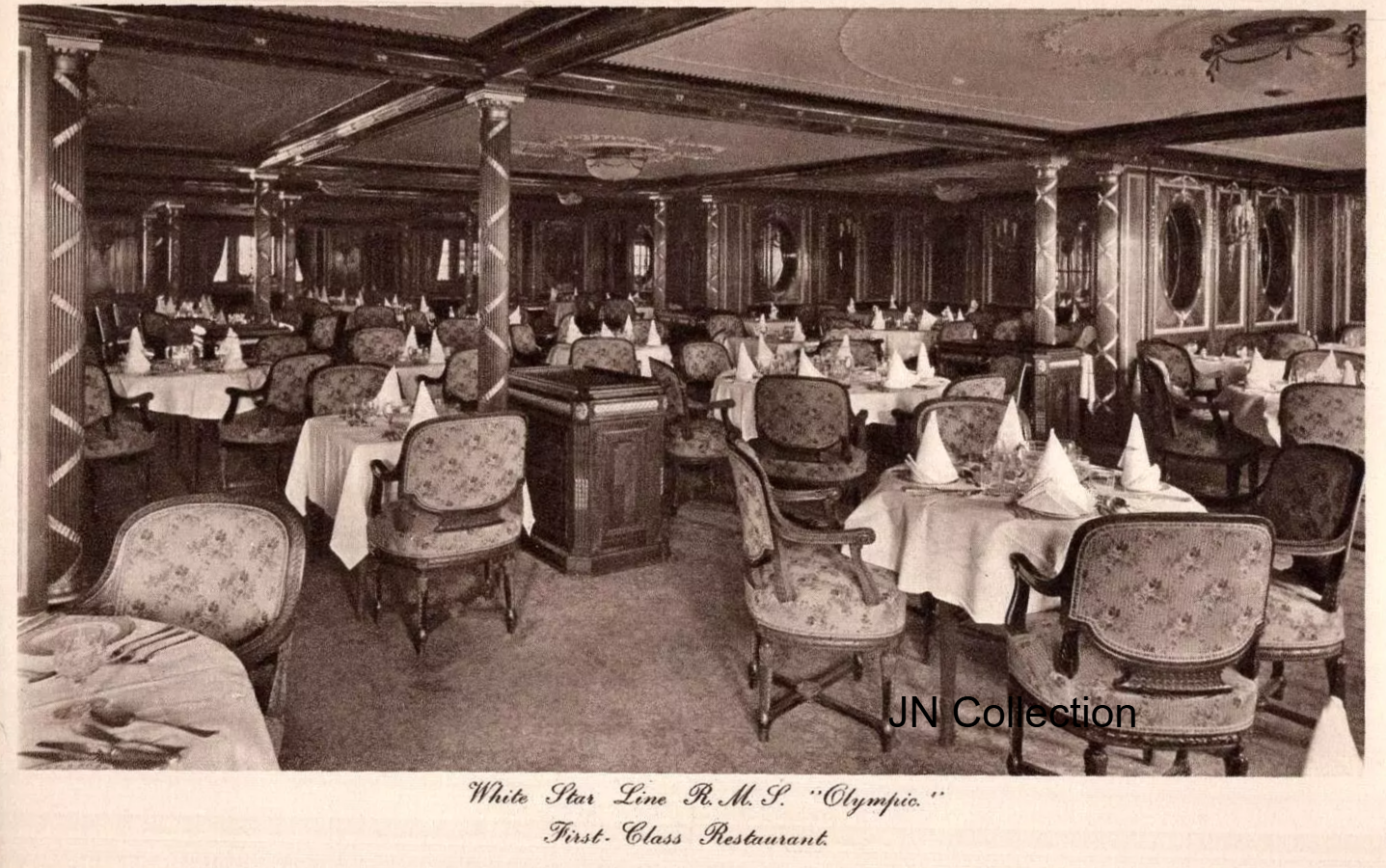
The A La Carte Restaurant on Titanic's nearly identical twin sister ship Olympic.
Author's Collection
On April 14, the weather temperatures began to plunge as the Titanic went further into the North Atlantic. In the morning, 1st class passenger Helen Churchill Candee recalled that the James Clinch Smith invited her and Mrs. Astor to tea. However, Helen already had plans to play bridge with Hugh Woolner and they decided to schedule it for the following day. At some point, Colonel Astor mentioned to Madeleine that he planned to send a wireless message to Mr. Dobbyns which included instructions to meet them when the ship docked in New York. For their final meal on board, the Astors were observed eating in the A La Carte Restaurant which was a special restaurant not included in the price of the 1st class ticket. That same evening, there was a dinner party hosted by the Wideners in the restaurant with Captain Smith attending as the guest of honor, though the Astors were not at their table. Lady Duff Gordon recalled that they had their own table and seemed to her to be much in love. Following dinner, 1st class passenger William Sloper observed the Astors with a number of other notables passing through the 1st class Lounge while Sloper and his friends were playing bridge. Because she was not feeling well, Madeleine went to bed early.
After The Collision
At 11:40 PM, the Titanic struck an iceberg causing her to begin to sink and the engines to stop. Both Colonel Astor and Madeleine were awaked by the either by the lack of engines running or the shock of the collision (there are different versions reported). Madeleine asked Colonel Astor what happened and said it was nothing, that the engines would start back up again. The engines did start up again, but then stopped again. Colonel Astor looked out the window of their cabin and remarked that there was ice about. He got dressed and went out to find out what was happening. As passengers began to file out, the Colonel Astor gathered with the other honeymoon couples on the Grand Staircase. 1st class passenger Helen Bishop said, “After being there about 5 or 10 minutes one of the men we were with (Col. Astor) ran up and spoke to the captain, who was just coming down the stairs…The captain told him something in an undertone.”-US Inquiry
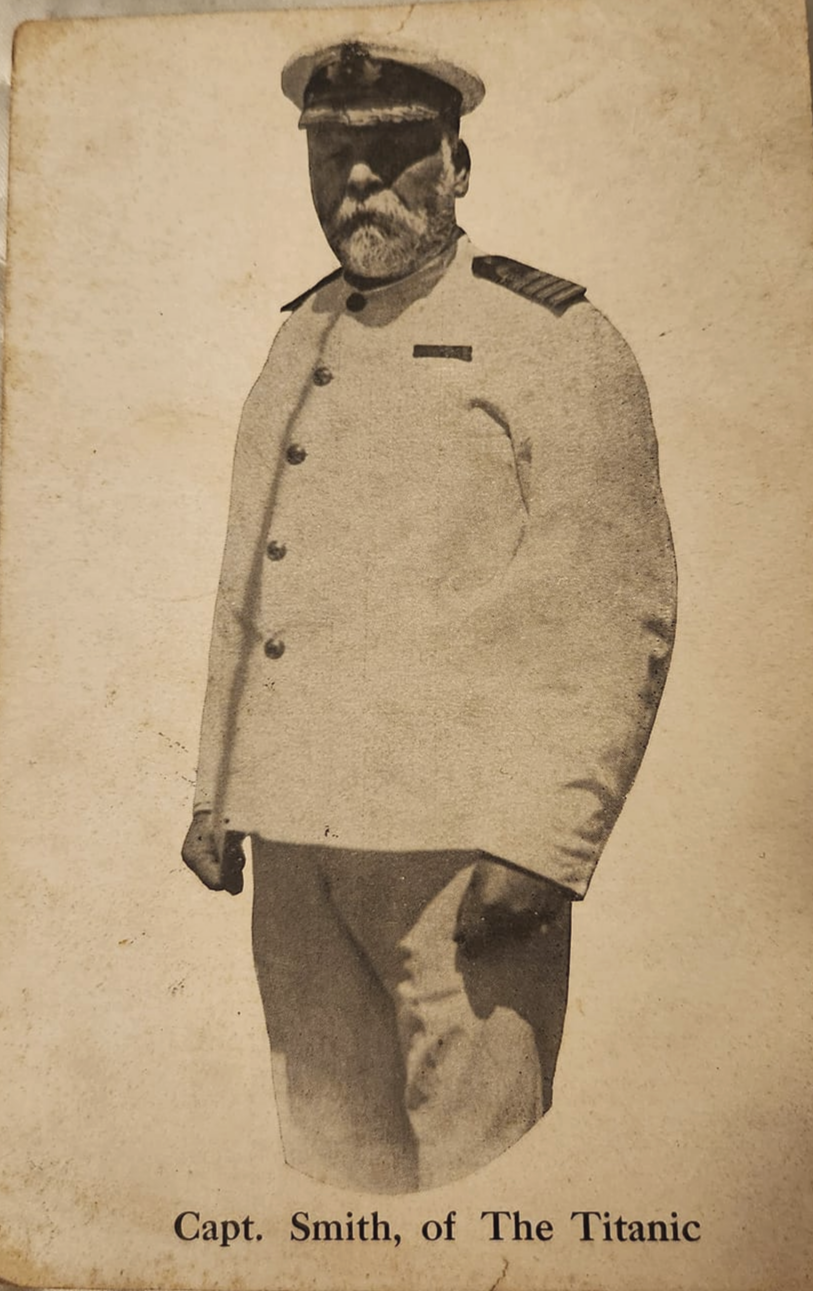
Captain E.J. Smith
Author's Collection
Thankfully, Isaac Frauenthal overheard this conversation on the staircase so we can know what was discussed. He later said, “Presently, I saw the Captain appear, apparently from the bridge, and several men approached him. One of these was Col. Astor and I heard him say to Capt. Smith: “Captain, my wife is not in good health. She has gone to bed and I don’t want to get her up unless it is absolutely necessary. What is the situation?” Capt. Smith replied quietly, “Col. Astor you had better get your wife up at once. I fear we may have to take to the boats.” After Captain Smith continued his descent down the staircase, Colonel Astor returned to the group of people and told them they had better get their lifebelts on. There are conflicting accounts on whether Madeleine was there or not. Helen and Dickinson Bishop recalled seeing her. Nellie Snyder who was also in their group did not. Given how Astor was reported to have asked if it was necessary to wake his wife up, it is possible that the Bishops may have been mistaken in their recollections, especially since Sir Cosmo who ran into Colonel Astor shortly after this did not mention Madeleine being with him.
Part II
After Captain Smith hinted at the Titanic’s situation possibly being serious, the Astors went down to their cabin. As they were enroute, Colonel Astor encountered Sir Cosmo Duff-Gordon; he told him that he was going to get his wife up and dressed and suggested that Sir Cosmo do the same thing. Colonel Astor returned to their cabin to get dressed in warmer clothing and put on their life jackets. From an adjacent cabin, Daisy Minahan said she could hear Madeleine crying. Madeleine chose to put on some jewelry including the gold brooch with roses pictured below, her engagement ring, and a string of pearls. Some of the papers later reported that Madeleine wore just a nightgown during the sinking. However, that jewelry suggests that she was fully dressed. She also wrapped a white silk scarf around her neck to help her keep warm. Colonel Astor for his part had dressed warmly, wearing a brown flannel shirt, blue serge suit, and brown boots with red rubber soles. He donned his 18-karat gold cufflinks which were monogrammed with JJA and picked up his 14 carat Tiffany pocket watch which also had JJA monogrammed on the case. Joined by Endres, Bidois, and Robbins, the group left their cabins and headed upstairs.
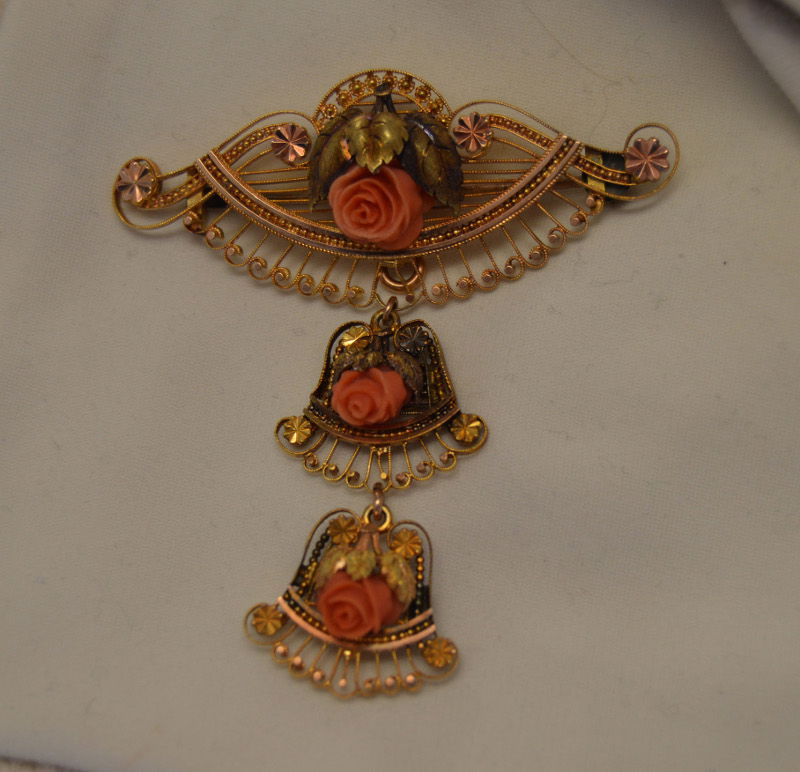
The brooch Madeleine Astor wore the night of the sinking.
Credit: Cumberland County Historical Society
As the lifeboats began to be readied for launch, passengers began to come out on deck. On the port side of the A-Deck Promenade, the Astors decided to join others waiting in the cold. Caroline Bonnell recalled that, “When I got back with her (Elizabeth Bonnell), there were crowds of people standing all around. Nobody seemed very excited; everyone was talking and it seemed to be the general idea that we would soon be ordered back to bed. Just then an officer came to us and said we should go up to the next deck-the boat deck. By that time nearly everyone was up. Mrs. John Jacob Astor was there sitting in a steamer chair. Her husband, Col. Astor, was beside her and a maid was helping her to finish dressing. There was no confusion here even yet, although we noticed that the boat was beginning to list to the starboard considerably.” From inside the ship, they could hear the band begin to play lively music. While Madeleine sat on the deck chair, Colonel Astor placed warmer clothing on her and tied her life jacket on her.
Colonel Archibald Gracie IV (who would have known the Astors in New York and was related through the marriage of Gracie’s aunt and Colonel Astor’s distant cousin) briefly conversed with him. He later wrote, “Our hopes were buoyed with the information, imparted through the ship’s officers, that there had been an interchange of wireless messages with passing ships, one of which was certainly coming to our rescue. To reassure the ladies of whom I had assumed special charge, I showed them a bright white light of what I took to be a ship about five miles off and which I felt sure was coming to our rescue. Colonel Astor heard me telling this to them and he asked me to show it and I pointed the light out to him. In so doing we both had now to lean over the rail of the ship and look close in towards the bow, avoiding a lifeboat even then made ready with its gunwale lowered to the level of the floor of the Boat Deck above us and obstructing our view; but instead of growing brighter the light grew dim and less and less distinct and passed away altogether.”-The Truth about the Titanic (1913)
Also present there were Ida and Isidor Straus with their staff, Robert Daniel, Maurice Bjornstrom-Steffanson, and Hugh Woolner
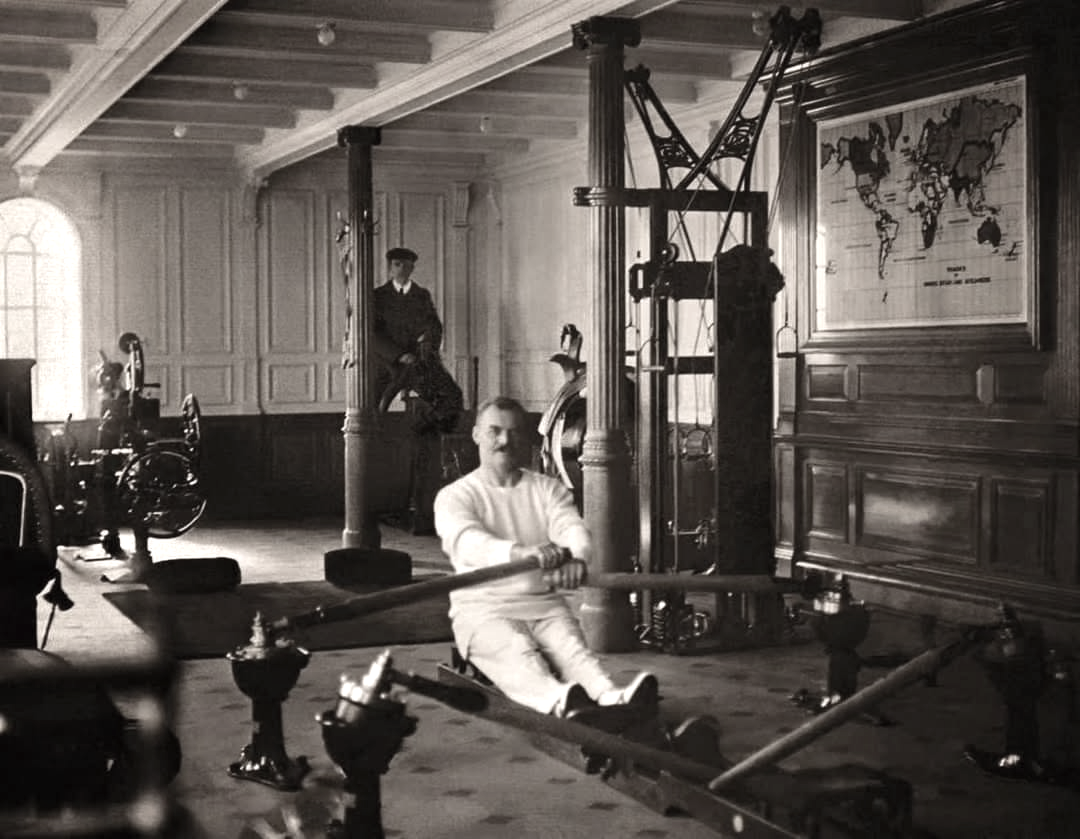
The Titanic's Gymnasium with gym instructor T.W. McCawley at the rowing machines. The mechanical horse the Astors were standing at is in the back right corner with a man on top of it.
Credit: Father Francis Browne/E.E. O'Donnell
Presumably due to the cold and the noise from the funnels releasing steam, the Astors did not remain out on deck for very long. Instead, they went upstairs to the gymnasium on the Boat Deck level. Even then, Colonel Astor doesn’t appear to have realized the gravity of the situation he was in. Barber Augustus Weikman recalled that, “I went to the gymnasium to see whether others had noticed it. I found some of the men punching the bag, with Colonel Astor, Mr. Widener, and a number of others watching them. I had known Mr. Widener for some time, and I advised him to put on a lifebelt. He laughed at me. “‘What sense is there in that? This boat isn’t going to sink,’ he said to me. ‘There is plenty of time. We’re safer here than in a small boat, anyway.’”
Spencer Silverthorne also recalled seeing them in the gymnasium saying, “It was while on our way to the deck the last time I saw Col. and Mrs. Astor. They were alone in the ship’s gymnasium, sitting together on a ‘horse.’ Col. Astor was smoking a cigarette and tying a life preserver around his bride. He already had one on and I think she arranged the fastenings on him just as we came in. They did not seem to take the situation seriously, as in fact, none of us did, and acted to me as if they thought it was a joke. I did not see either of them come on deck.”
Women and Children First
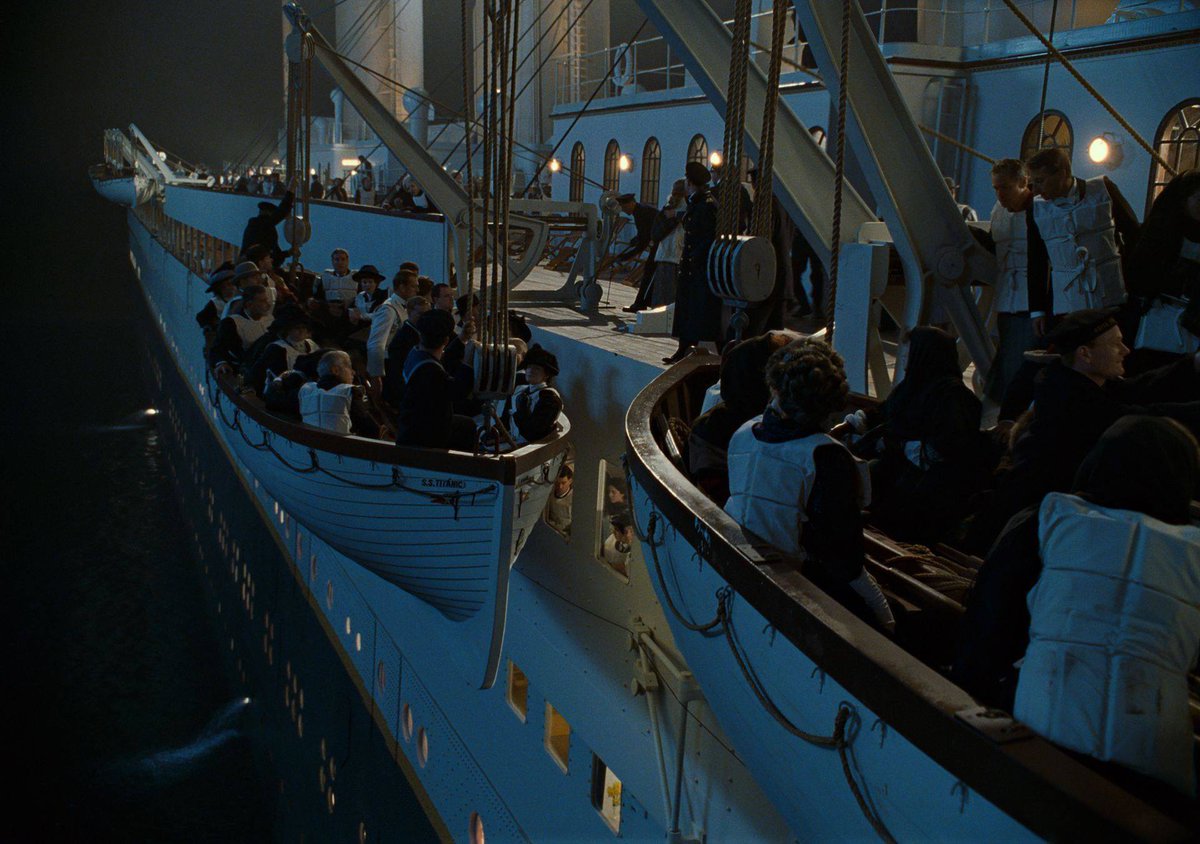
Boats No. 5 (foreground) and 7 (background) are launched in Titanic (1997).
Credit: 20th Century Fox
They eventually did go out on the Boat Deck when Boats 5 and 7 were the first to be launched from the ship. As they were readying the boats, Dr. Washington Dodge Sr. noticed that Colonel Astor was standing near Captain Smith and Major Archibald Butt conversing. The first lifeboat to be lowered from the Titanic and the Astors had the opportunity to join the passengers including men in the boat. William Sloper said, “Colonel Astor was directly behind me with Mrs. Astor, and he suddenly drew back and pulled his wife back with him. Someone spoke to him but I did not hear what was said. At any rate, they did not follow us into the boat. ”Likewise, Dorothy Gibson and Fred Seward also claimed that they were about to get into a boat when they suddenly turned back when someone spoke to them.
Lily Potter said, “I saw Colonel and Mrs. Astor standing at the rail as we rowed away, and they declined to be taken off, claiming that it was safer on the big liner than in the cockle-shells amid the floating ice. They simply would not believe that there was any danger.”-New York Tribune April 20, 1912 p. 4
This seemingly cavalier attitude towards what was happening on the Titanic that multiple survivors reported seeing when they encountered the Astors may have had deadly consequences. Multiple men got into these early boats without much objection. If the Astors had taken the opportunities in front of them, both of them may well have been saved.
After Boat No.7 was lowered, Boat No. 5 was launched. Anna Warren saw the Astors near this boat as well. She later told a reporter from the Portland Oregonian, "The only people we remembered seeing, except a young woman by the name of Miss Ostby, who had become separated from her father and was with us, were Mr. Astor, his wife and servants, who were standing near one of the boats which was being cleared preparatory to being lowered. The Astor's did not get into this boat. They all went back inside and I saw nothing of them again until Mrs. Astor was taken onto the Carpathia.“We discovered that the boat next to the one the Astor's [boat #5] had been near had been lowered to the level of the deck, so we went towards it and were told by the officer to get in.”-Portland Oregonian April 27, 1912
Later on during the sinking, Jacques and May Futrelle descended to A-Deck where a group of men had congregated. May recognized Colonel Astor as being one of those men while Jacques conversed with them. May remembered that they were mostly quiet, but some did comment even that late in the sinking about how the ship could not sink. For some of the sinking at least, Colonel Astor is believed to have assisted with getting people into lifeboats. Archibald Gracie IV, Irene Harris, and other survivors mentioned Astor as being among the famous 1st class men they saw bravely and heroically trying to get women and children into boats without trying to save themselves.
As 3rd class passenger Leah Aks emerged on deck with her 10 month old baby Frank, Madeleine saw them and wrapped her silk scarf around her to try and help keep them warm. The Aks family kept that scarf in their family for many years after that. It should be noted that 3rd class passenger Daniel Buckley did claim that he got into a lifeboat with other men and Mrs. Astor threw a shawl over him in order to prevent the officers from seeing he was a man and forcing him to get out like the other men who boarded that boat as well. However, Mr. Buckley was in a completely different boat from Mrs. Astor and it is believed to have been a case of mistaken identity.
Boat No. 4
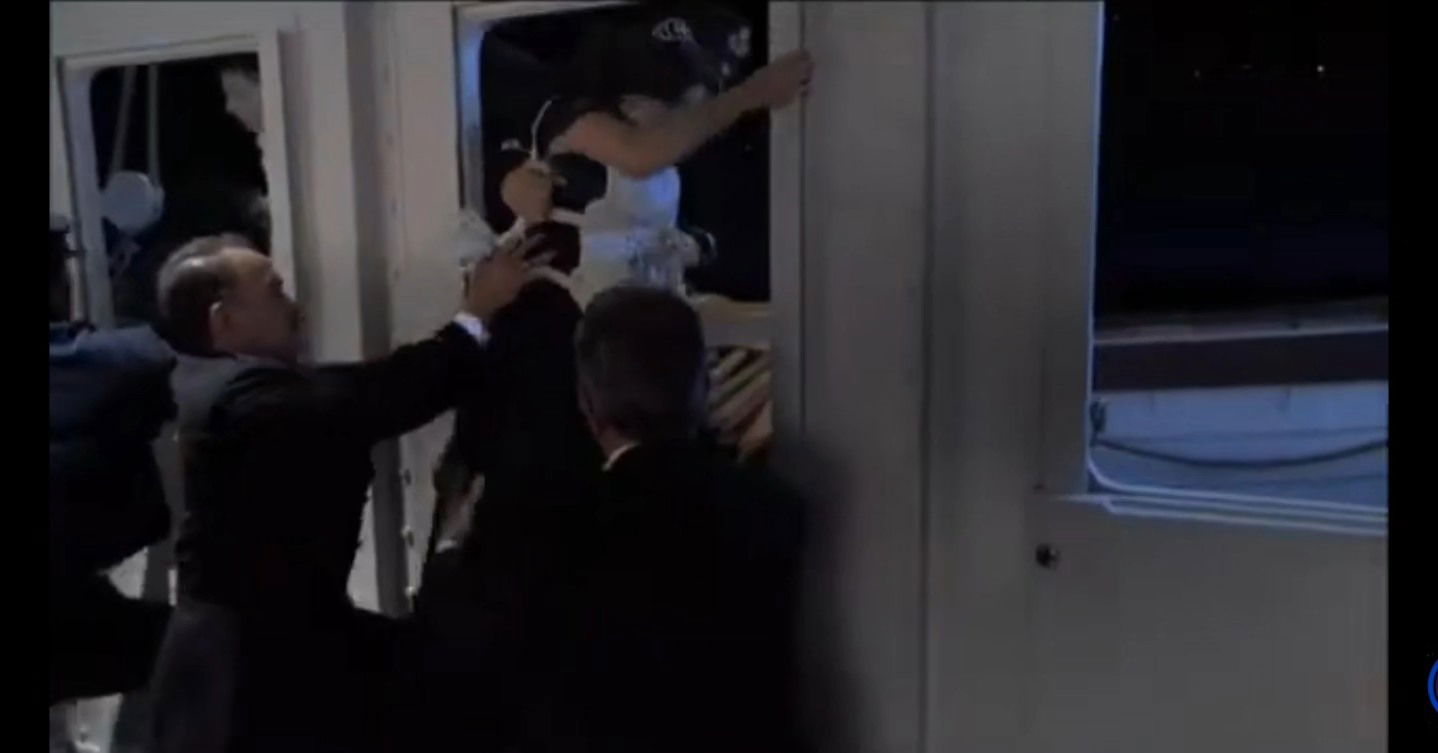
Madeleine Astor climbing through a window into Boat No. 4 with Colonel Astor and Colonel Gracie helping her. This was recreated for the documentary Ghosts of the Abyss.
Credit: Walden Media
Boat No. 4 was one of the last boats to safely leave the ship. It had been lowered to the forward A-Deck promenade where windows enclosed it by 2nd Officer Lightoller, and then left there because no one had found the key to open the windows. When the windows were finally lowered, the crew began funneling passengers through the windows to the boat. Something that would have appeared dangerous for those on board to cross over. To make matters worse, there was a gap between the boat and the side of the ship due to a heavy list to port. By this time, the lights of the ship were dimmer and some of the wives of those prominent names in 1st class who were mentioned by survivors as cavalierly acting like the ship wasn’t truly in danger made their way toward this boat. In addition, multiple 3rd class passengers had made their way to the top decks and were joining the attempts to get in unlike the earliest boats they were offered seats in and the rule of “women and children first” was being more strictly enforced. It is unclear why Colonel Astor did not make an attempt to put Madeleine into a lifeboat sooner. I can only speculate that he feared how being in a small boat would affect his 5 months pregnant wife. It should also be pointed out that according to a letter sent by Mr. Dobbyns, Madeleine did not want to leave her husband. He said that when they approached the boat, she asked him not to leave her and he told her that he wouldn't. As this moment was talked about a lot in the aftermath, multiple survivors did describe when Madeleine got into the boat with her maid Rosalie Bidois and her nurse Caroline Endres. As preparations were made for this boat, Colonel Astor and Madeleine decided it was time for them to leave in a boat. Up until this point, Colonel Astor was named by multiple survivors as assisting with getting other people in the boats. The same thing appears to have happened with Boat No. 4.
1st class passenger Elizabeth Eustis told the Boston Herald that, “I probably owe my life to Col. John Jacob Astor, who conducted me through the thronged deck to a lifeboat, forced me into it and said, ‘Good-by and God bless you. Col. Astor’s courage was superb in those harrowing moments, and I can say the same for Maj. Butt and Mr. Thayer, whom I saw still on deck aiding women and children as we were rowed away. Col. Astor and Maj. Butt seemed to be everywhere in their work of mercy and rescue, never giving a thought to themselves, never stopping even to put on a life belt. Of course, there were scores, yes hundreds of other men who bore themselves as heroes from first to last.”
When it was their turn, the Astors approached the boat with their staff. 1st class passenger Mauritz Bjornstrom-Steffanson said, “I first saw Astor helping to load some steerage women into the lifeboats,” said Steffanson, “and a few minutes later, on an upper deck, I met Mrs. Astor. I said to her: ‘Why, Mrs. Astor, haven’t you left yet?’ Then Colonel Astor came up and said to her: ‘I’ve been looking for you, dear; you must get into a lifeboat.’ The two of us helped her into a boat, and just then an officer called out: ‘Lower that lifeboat!’ Astor put his hand on his wife’s shoulder, leaned over her for a moment, and said: ‘Goodby, sweetheart; don’t worry.’ He kissed her, and then as the boat was lowered away he smiled and waved his hand to her.”-New York Tribune April 19, 1912 p. 2
Storekeeper Jack Foley said, “While waiting up there Mrs. Astor several times wanted to get out of the boat. Colonel Astor kept telling the little woman that he was sure to be saved, and that it was her duty to go. She stretched out her arms just as though she was pleading with him to let her get out of the boat and take her place with him. Mr. Astor picked up a heavy steamer shawl and wrapped it about her shoulders.”-Chicago Examiner April 20, 1912
1st class passenger Martha Stephenson wrote that, “The only gentleman I remember seeing at all was Colonel Astor, who was stepping through the window just in front of me when the crew said, ‘Step back, sir; no men in this boat.’ He remarked that he wanted to take care of his wife, but on being told again that no men could go, he called ‘Goodbye’ and said he would follow in another boat, asking the number of our boat, which they said was ‘No. 4.’--On Board RMS Titanic: Memories of a Maiden Voyage by George Behe
The boat May Futrelle got into is somewhat unclear due to how much her accounts varied either due to a faulty memory, her career as a writer, how traumatic her experience was, or all of the above. However, there are at least two accounts which tell similar stories that have her getting into Boat No. 4 and seeing Colonel Astor. Since we were not there, I felt these accounts needed to be included. In one account, she said, “The last I saw of my husband he was standing beside Colonel Astor. He had a cigarette in his mouth. As I watched him, he lighted a match and held it in his cupped hands before his face. By its light I could see his eyes roam anxiously out over the water. Then he dropped his head toward his hands and lighted his own, and their faces stood out together as the match flared at the cigarette tip. I know his hands must have trembled. This was an act of bravado. Both men must have realised that they must die.”-On Board RMS Titanic: Memories of a Maiden Voyage by George Behe
In another account, May said, “They were filling the fourth boat when I came out, and the first thing I saw was Colonel Astor standing among the women. I wondered if he were saving his skin. If his influence had got him a place. I am sorry for that thought now-he himself explained a moment later. An officer stepped up to him and said: ‘Only women are allowed in this boat.’ Though the night was freezing cold, the perspiration was dripping from his face as he turned it toward the light. ‘I know that perfectly well,’ replied Colonel Astor. ‘I am only making my wife comfortable. She is ill.’ Then he stooped down, kissed her and jumped out on deck again. Before he left he asked: ‘What is the number of this boat? I suppose he wanted to identify it in case of rescue. They told him that it was Number 4; he nodded and started below. I didn’t understand until later how he came to be on that deck at all. It appears that his wife had fainted when she learned that she must leave him, and he had got permission to help the nurse carry her. I have thought since that he was the most heroic of all. He had entered the place of safety and left it again voluntarily…The men on Deck B stood strung along the rail smoking. I looked over them, sure that I would pick out Jacques by his great height. A match flared up and I saw that it was my husband giving a light to Colonel Astor.”-On Board RMS TItanic: Memories of a Maiden Voyage by George Behe
Years later, 3rd class passenger Elias Nicola-Yarred recalled that, “The last lifeboat was being loaded. A middle-aged gentleman was with his very young, pregnant wife. He helped her into the lifeboat, then looked back to the deck and saw others wanting to get aboard. He kissed his wife good-bye, and, returning to the deck, grabbed the first person in his path. Fortunately, I was there in the right place at the right time and he put me into the lifeboat. I screamed for my sister who had frozen from fright. With the help of others, she also was pushed into the lifeboat. Who was the gallant man who performed this kind act? We were told he was John Jacob Astor IV. At that time he was 45 years old and his wife, Madeleine, was 19. They were traveling to the United States because they wanted their child to be born there. Many newspaper stories were written that told how John Jacob Astor gave up his life for a young immigrant. The Astor family records indicate that, according to Mrs. Astor, Mr. Astor had words with a crewman who tried to prevent him from helping his wife into the lifeboat. He did so anyway. And, as I said, he kissed her and, returning to the deck, began helping others into the lifeboat.”-Awake! Magazine October 11, 1981
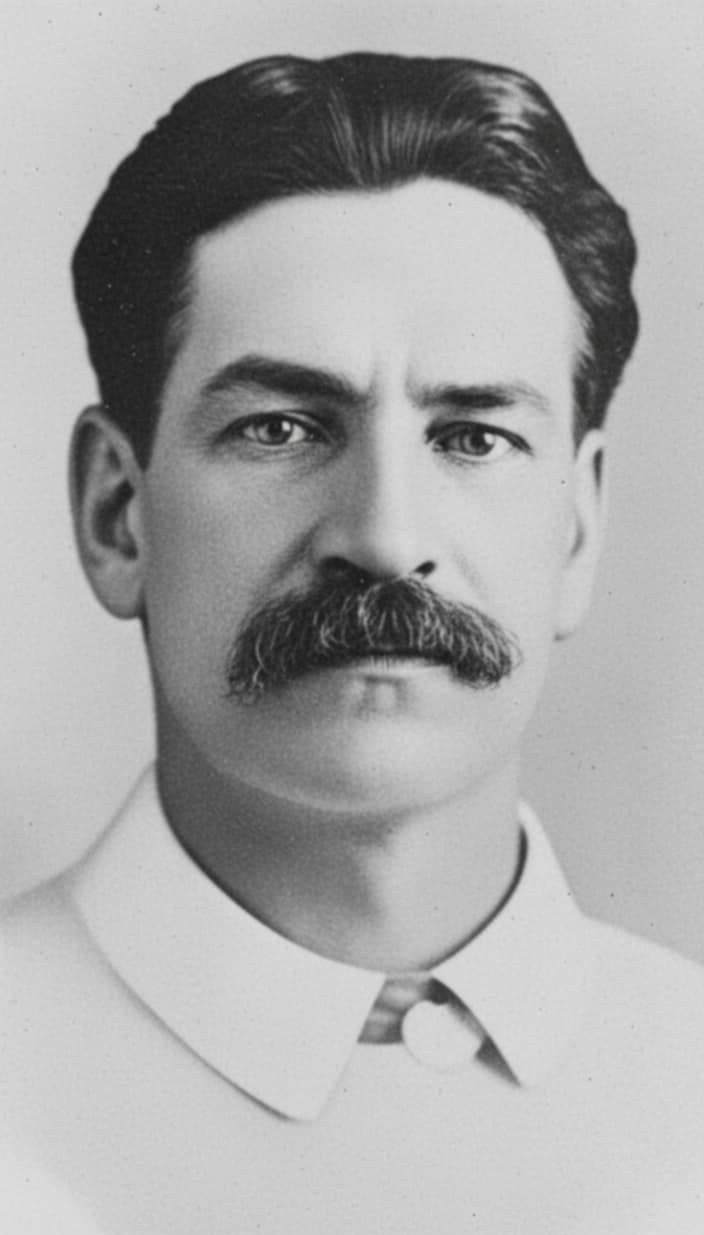
Colonel Archibald Gracie IV
Credit: New York Tribune December 1912
Perhaps the best and most detailed account of John and Madeleine’s parting comes from Col. Gracie who was standing right there beside the Astors. He wrote in his book that, “At this quarter I was no longer held back from approaching near the boats, but my assistance and work as one of the crew in the loading of boats and getting them away as quickly as possible were accepted, for there was now no time to spare. The Second Officer, Lightoller, was in command on the port side forward, where I was. One of his feet was planted in the lifeboat, and the other on the rail of Deck A, while we, through the wood frames of the lowered glass windows on this deck, passed women, children, and babies in rapid succession without any confusion whatsoever. Among this number was Mrs. Astor, whom I lifted over the four-feet high rail of the ship through the frame. Her husband held her left arm as we carefully passed her to Lightoller, who seated her in the boat. A dialogue now ensued between Colonel Astor and the officer, every word of which I listened to with intense interest. Astor was close to me in the adjoining window-frame, to the left of mine. Leaning out over the rail he asked permission of Lightoller to enter the boat to protect his wife, which, in view of her delicate condition, seems to have been a reasonable request, but the officer, intent upon his duty, and obeying orders, and not knowing the millionaire from the rest of us, replied: “No, sir, no men are allowed in these boats until women are loaded first.” Colonel Astor did not demur, but bore the refusal bravely and resignedly, simply asking the number of the boat to help find his wife later in case he also was rescued. “Number 4,” was Lightoller’s reply. Nothing more was said. Colonel Astor moved away from this point and I never saw him again. I do not for a moment believe the report that he attempted to enter, or did enter, a boat and it is evident that if any such thought occurred to him at all it must have been at this present time and in this boat with his wife. Second Officer Lightoller recalled the incident perfectly when I reminded him of it. It was only through me that Colonel Astor’s identity was established in his mind. “I assumed,” said he, “that I was asked to give the number of the lifeboat as the passenger intended, for some unknown cause, to make complaint about me.”-The Truth About The Titanic (1913)
Col. Gracie also testified at the US Inquiry that, “The only incident I remember in particular at this point is when Mrs. Astor was put in the boat. She was lifted up through the window, and her husband helped her on the other side, and when she got in, her husband was on one side of this window and I was on the other side, at the next window. I heard Mr. Astor ask the second officer whether he would not be allowed to go aboard this boat to protect his wife. He said, ‘No, sir; no man is allowed on this boat or any of the boats until the ladies are off.’ Mr. Astor then said, ‘Well, tell me what is the number of this boat so I may find her afterwards,’ or words to that effect. The answer came back, ‘No. 4.’”-US Inquiry Day 11
11 year old William Thorton “Billy” Carter II was a son of prominent people on the Titanic from Philadelphia. He also boarded Boat No. 4 with his mother and sister (both named Lucile Carter). According to family friends, he dispelled a rumor that Colonel Astor placed a woman’s hat on him in order to allow him to get into the lifeboat with Lightoller having a strict anti-man policy. However, he is believed to have said that he had his own dog Mogul with him which is said to have been an Airedale. When he was boarding a lifeboat, he was told that the dog could not join him. Billy said that Colonel Astor took the dog’s leash promising to look after him. No doubt, Colonel Astor’s fondness for the breed influenced him to make this gesture. There is no known direct writing or transcript of Billy saying this, but it’s the best we have since Billy largely avoided talking about the Titanic for the most part in public or in private except for a few private conversations until his death in 1985.
When the boat was loaded and Lightoller gave the order to lower, Colonel Astor and Victor Robins stood with other men such as John B. Thayer, Arthur Ryerson, and George D. Widener who made no attempt to save themselves. They calmly waved as their wives’ faces became silhouettes in the darkness. The boat had a shorter distance to descend as the bow sank lower in the water. Fellow occupant Emily Ryerson even remembered looking into the portholes seeing water pouring into cabins. When the boat reached the water, Lightoller was informed that not enough men were there to man the boat. He sent Quartermaster Perkis down the falls. There were a total of 30 people lowered in Boat No. 4 when it was designed to have had 65 which would haunt some of the women in the boat, believing that their husbands could have survived if they were allowed on.
It has been suggested that Colonel Astor was responsible for releasing the dogs from the kennels. However, this is in doubt since he was never credibly seen on the aft end of the Boat Deck near the kennels and Robert Daniel’s account points more towards him being the one that released the dogs. We know that someone did as R. Norris Williams encountered Mr. Daniel’s French Bulldog in the water, but there is no verifiable eyewitness account that has Colonel Astor doing this. What is known is that Kitty unfortunately was one of the Titanic victims as well as the Carter family’s dogs.
The Sinking of the Titanic
On board the Titanic, Astor sightings seem to have dissipated after Boat No. 4 was launched. The last sighting we have of him comes from Augustus Weikman who said, “I was standing beside Colonel Astor when the ship started to take her last plunge. I told him I was going to jump. ‘You’re a fool to jump,’ he said. ‘There are several more rafts on board. ‘There are no more rafts,’ I told him. ‘For God’s sake, get a life preserver and jump!’ ‘I’m not going to jump,’ he said. ‘There must be another raft.’ ‘Then he put out his hand and we shook. I jumped.’” This indicates that Astor likely crossed from the port side to the starboard side and was on the forward Boat Deck after his wife was lowered in the boat . Gracie was also in that area, though he said he never saw Astor after Boat No. 4 despite noting that John B. Thayer and George Widener also crossed over to the other side. Gracie went on to describe a wave that washed over the Boat Deck as the ship suddenly lurched downward and plunged that area under the waves if Colonel Astor had not jumped prior to that. It should be noted that when Astor’s body was found, it was noted that “one jaw was injured.” This was a common injury for those who jumped wearing that type of life jacket since the cork blocks were located right below the jaws and had a tendency to pop up into the wearer’s jaw or neck. This design flaw was recognized and that design was largely phased out following WWI. The mention of his jaw being broken could honestly have been a number of things as the sinking was pretty violent, but it indicates that he likely jumped from the ship before she went down.
Colonel Astor’s death is a matter of some controversy and speculation. For years, it was claimed that his body was found crushed with soot on it, leading many to believe that he was crushed by the No. 1 funnel when it fell on people. This speculation stems from soon after the sinking as Gracie wrote in his book, “From the fact that I never saw Colonel Astor on the Boat Deck later, and also because his body, when found, was crushed (according to the statement of one who saw it at Halifax, Mr. Harry K. White, of Boston, Mr. Edward A. Kent’s brother-in-law, my schoolmate and friend from boyhood), I am of the opinion that he met his fate on the ship when the boilers tore through it, as described later.” Later books described the body as crushed and covered in soot and speculated that he was crushed by the No. 1 funnel. This led to a general assumption by many in the Titanic community that he was killed by the No. 1 funnel. However, historian George Behe has done great research into this which has included first hand accounts that do not mention that the body was crushed but instead say the opposite. It can be surmised that Astor’s cause of death was drowning or hypothermia, like most of the Titanic’s victims. To read his evidence on the matter, the link is below:
https://web.archive.org/web/20020408102620/http://ourworld.compuserve.com/homepages/Carpathia/page12.htm
From Madeleine’s perspective, the nightmare was ongoing as well. Yet, she acted bravely. Storekeeper Jack Foley was one of the rowers who sat on the seat across from her. He said, “When the explosion occurred aboard the Titanic Mrs. Astor made some kind of a sound, but I couldn’t understand whether she said anything or merely sobbed. She turned her head away from the direction of the vessel. When the ship went down, and that awful moan was heard, she didn’t say anything, but covered her face with her hand. The steerage woman who sat beside her tried to cheer her up...The women in the boat seemed to all be interested in Mrs. Astor. It wasn’t because she was rich. That didn’t count was up there in the ice floes. I heard one woman whisper to another woman and point to Mrs. Astor when she had her face covered with her hands.”-Chicago Examiner April 20, 1912 According to a letter Mr. Dobbyns sent later, she thought she heard her husband's voice calling and cried out responding that they were coming, but the people in the boat made her stop. At one point, Madeleine did speak up for picking up people in the water. Rosalie Bidois was also said to have “played a conspicuous part” in helping men in the water get into the boat. 1st class passenger Virginia Clark recalled that, ““They even went so far as to impede the rowers,” said Mrs. Clark. “Mrs. Astor, among others, insisted that the boat return to the sinking ship, but as we approached her, the Titanic sank, followed by two almost simultaneous explosions.”-New York Tribune April 25, 1912 p. 3
Jack Foley told the Chicago Examiner that, “Boat No. 4 of the Titanic, containing Mrs. John Jacob Astor, was about 100 yards from the liner when it came close to an overturned lifeboat, to which nine or ten men were clinging, almost exhausted, and chilled to the bone. In desperation several of the men loosened their hold on the overturned boat and swam to the other boat and grasped the edges which were close to the water. The men pleaded pathetically to be taken in. “Don’t take them in,” shouted some one. “This boat is too full already.” Mrs. Astor, who up to this time had not spoken since the boat was launched, cried out to Seaman Jack Foley, who was facing her rowing: “Take them in. They have as much right to life as we have. We can make room for them. Please, sir, take them in.” Jack Foley turned to his mate, Sam Parks (possibly Samuel Hemming), who had the oar behind him, and looked interrogatively at him. Parks nodded. Eight half frozen men were taken into the already crowded boat. Mrs. Astor thanked Foley and Parks, and the rescued men chattered their appreciation…After pulling those eight men into the boat I was pretty wet and shivering. Mrs. Astor threw the same shawl about my shoulders, and said that I needed it more than she did. I told her that I would get warmed up after pulling a while at the oar, and would have no use for it. I put the shawl back on her lap. Sitting next to Mrs. Astor was a Swedish woman with a little three-year-old girl. The little girl was whimpering with the cold. Mrs. Astor took the shawl and threw it about the shoulders of this woman. She thanked her in some foreign language and the steerage woman kissed her little girl and took her into her arms and wrapped the shawl about her…Some one wanted to throw the body overboard, but Mrs. Astor shook her head at me. We kept the body aboard the vessel.”-Chicago Examiner April 20, 1912
After the sinking, Boat No. 4 drifted for hours with water in the bottom of their boat at their feet. Madeleine was left in darkness processing what she’d witnessed that night hoping beyond hope that her Jack was saved from being among the screaming masses she listened to as their sounds faded away into silence.
Part III
Madeleine on the Carpathia
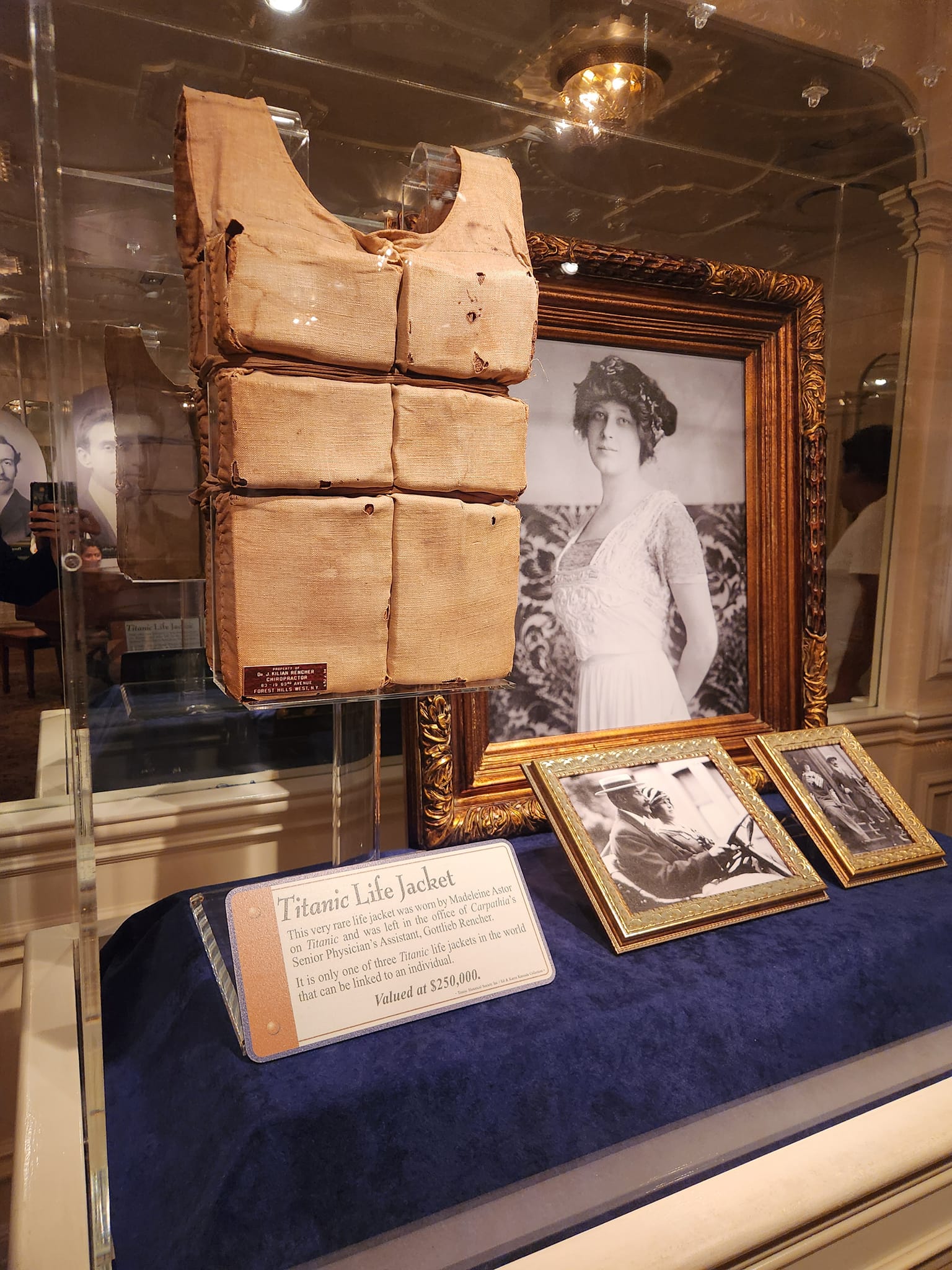
Madeleine Astor's life jacket
Credit: THS Collection/Titanic Museum Attraction/JN Photography
In the early morning, Madeleine was brought from Boat No. 4 on board the RMS Carpathia where she was brought to the office of Senior Assistant Doctor Gottlieb Rencher who helped her through the gangway door. When she arrived in his cabin, she took off her life jacket and left it there. Dr. Gottlieb kept the life jacket for the rest of his life and his family had it until it was donated to the Titanic Historical Society. After that, Madeleine had the rare privilege of having a private room which belonged to Captain Arthur Rostron himself. Most of the 712 survivors were forced to share beds, take open bunks, or even sleep on floors and tables. However, Madeleine was given a cabin on the Carpathia likely owing to her social status and pregnancy which she shared with her maid and her nurse. The ship’s doctor checked on her during the voyage. She largely stayed in her cabin on the way to New York. This was not viewed with disdain by her fellow survivors, but instead sympathy.
2nd class passenger Anna Dyker commented that, “After I had been put aboard I learned that Mrs. Astor had gone into violent hysterics and had been placed in a stateroom under the care of a nurse. I assisted in quieting her but she broke out afresh every little while. As I had lost my husband exactly as she had lost hers, I pitied her from the bottom of my heart.”-The Boston Herald
Carpathia passenger Anna Crain said, “Mrs. Astor and her maid were in the first boats that arrived, and she was immediately placed in the captain’s cabin.”-Voices From the Carpathia: Rescuing RMS Titanic by George Behe
Dr. Kemp, who was a Carpathia passenger, recalled that, “Mrs. Astor was almost full-dressed when she came aboard the Carpathia. She went straight to a cabin, where she was attended by the ship’s surgeon, and did not reappear again until we reached New York.”-Daily Graphic April 20, 1912 He told a different reporter that, “Mrs. John Jacob Astor had to be carried aboard. She had to be taken into a cabin and given medical attention. She was more completely attired, however, than many of the women who were rescued.”-Voices From the Carpathia: Rescuing RMS Titanic by George Behe
Carpathia passenger Dr. Arpad Lengyel told reporters when he got to New York that, “Mrs. Astor was not recognized because of the condition of her hair, which partially obscured her face. When her identity was learned she was put in the private stateroom from which she came out for the first time tonight.”-Voices From the Carpathia: Rescuing RMS Titanic by George Behe
Titanic survivor May Futrelle remembered catching a glimpse of Madeleine and said, “I saw poor Mrs. Astor and I shall never forget her face. It was strained and white and wore an expression of almost hopelessness. She was very delicate and spent most of the time in her stateroom.”-On Board RMS TItanic: Memories of a Maiden Voyage by George Behe
In addition to the Carpathia’s surgeon Dr. Frank McGee and Caroline Endres, fellow survivor Dr. Frauenthal also checked on her. Madeleine appears to have stayed largely in her cabin. Multiple people said she never left her cabin. However, some did talk to Madeleine and she doesn’t appear to have been completely isolated. Carpathia passenger Carlos Hurd wrote that, “Mrs. Astor said she spoke often of her husband’s ability as an oarsman and said he could have saved himself if he had a chance. That he could have had such a chance, she seemed hardly to hope.”-Voices From the Carpathia: Rescuing RMS Titanic by George Behe
On land, there was much confusion. At first, those closest to Colonel Astor were told that the Carpathia saved everyone and was headed to Halifax. They made arrangements to travel there to meet them, only to change plans when they learned that the Carpathia was heading straight for New York instead. They visited the White Star Line offices in New York often to see if there was more information of which there was little.
New York
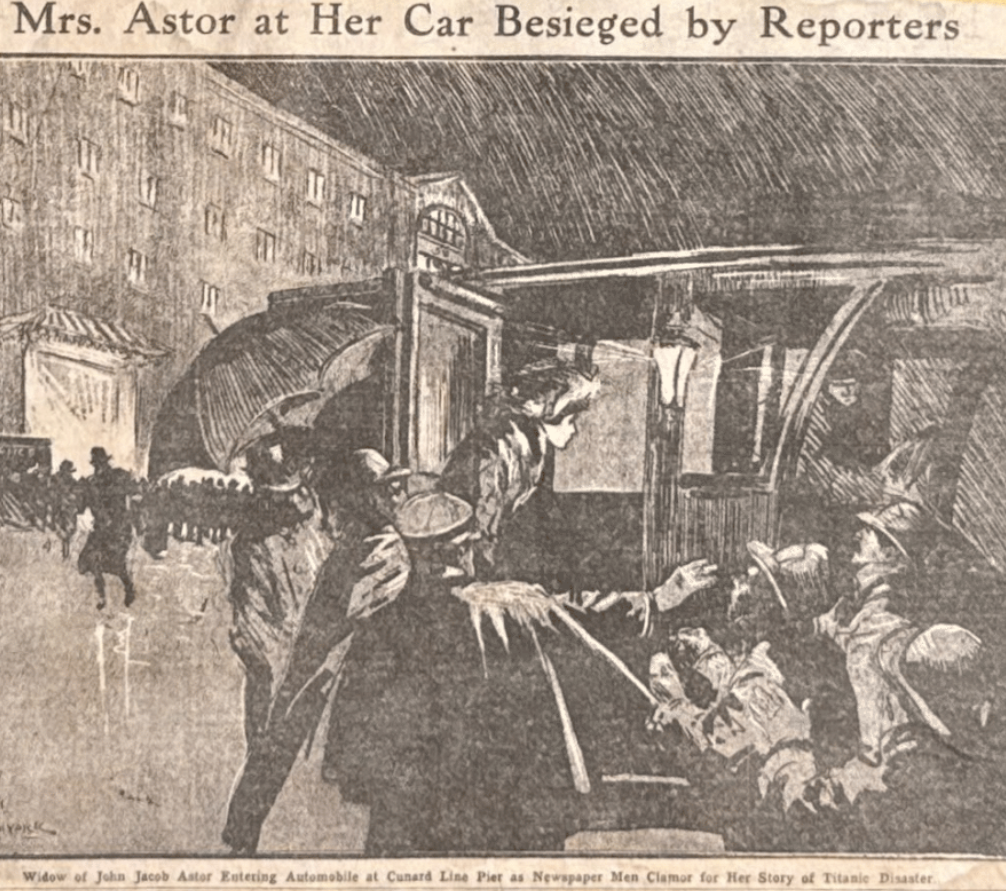
This is a period illustration of Madeleine Astor getting into Vincent's car as reporters attempt to get her story at Pier 54 from a Boston newspaper.
On the evening of April 18, 1912, people gathered on Pier 54 awaiting the arrival of the Titanic survivors on the Carpathia. Few details had been relayed to the press about the disaster and so the press and public alike were clamoring as close as they could get to where the survivors would disembark despite the rain. The Carpathia’s lights began to appear out of the distance. She first dropped the Titanic’s lifeboats including Boat No. 4 at the White Star Line berth Pier 59. Following that, the Carpathia went to the Cunard berth Pier 54 and docked. The first person down the gangplank was Dr. Frauenthal who was asked about Mrs. Astor. He confirmed that she was well. One by one, the survivors began to descend into an anxiously awaiting crowd. Vincent was able to get permission to board and fought his way through the crowds onto the Carpathia to retrieve his step-mother. After a while, Madeleine appeared with Rosalie and descended the gangplank. She was fully dressed, wearing a white sweater. Mr. Dobbyns greeted them along with Dr. Craquin, Mr. Kimball, a trained nurse, and an ambulance since the only word about her condition that they received was that she was very ill. As soon as they saw that Madeleine could walk, it was ascertained that an ambulance was not needed. Vincent then went over to his vehicle and started it while being questioned by reporters. He could give no update as he hadn’t dared to ask her about any details yet. He sped away from the waiting cars towards the shed where he picked up Dobbyns, Madeleine, and Rosalie. Inside the car was a suitcase with clothes for them to change. Their first stop was the Force mansion where Madeleine's family greeted her. After spending a little time there, she afterwards went to the Astor mansion at 840 Fifth Avenue.
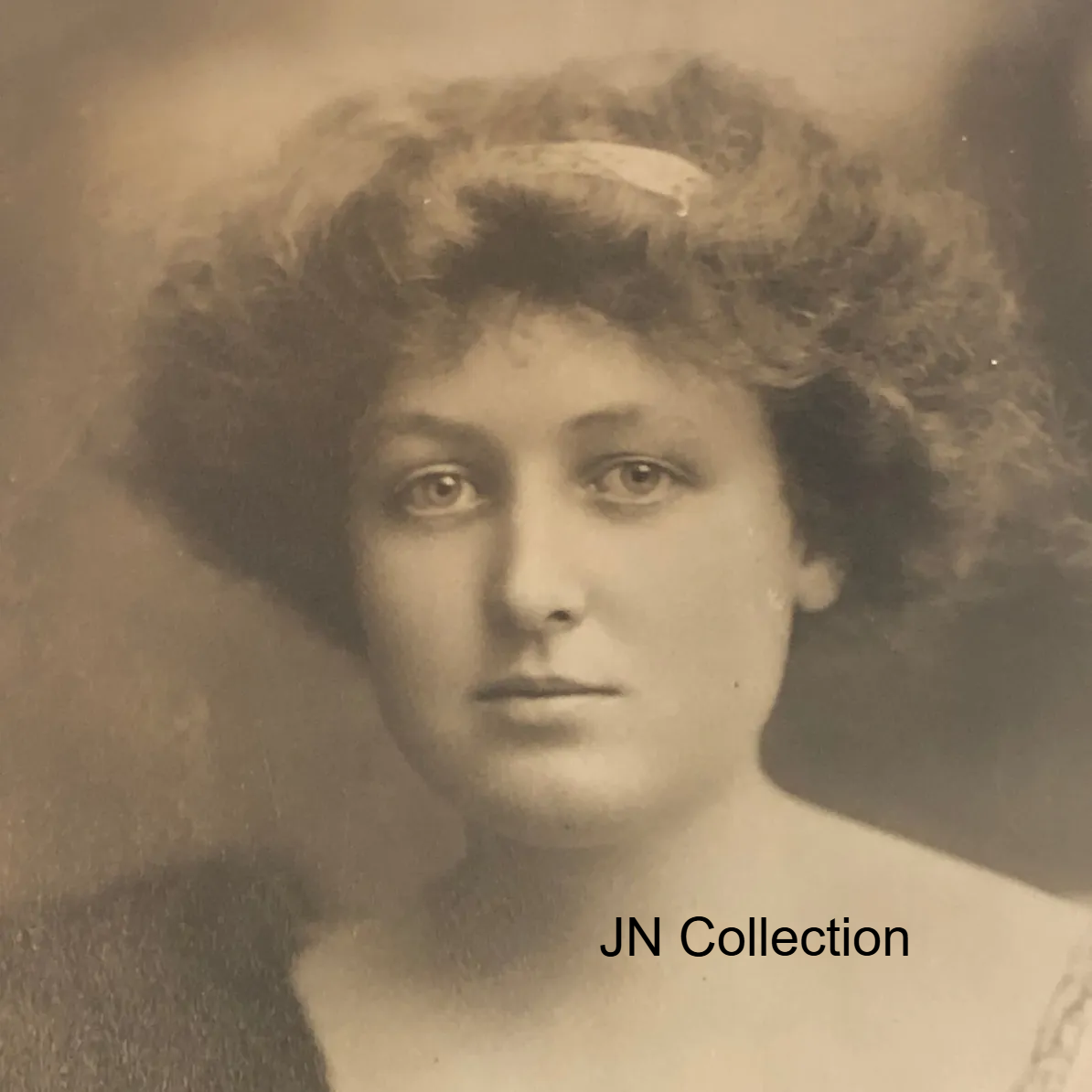
Madeleine's closest confidant, her sister Katherine Force.
Author's Collection
Dr. Ruel B. Kimball came to see Madeleine that evening and declared that she was not critical. However, they told her she couldn’t talk about the disaster. Prior to that, she did give pieces of what she remembered of the disaster. It is unknown if this is actually what the doctor prescribed without being prompted by others, or if this was something done to keep the press away from trying to interview her during what must have been an extremely emotional time. According to news reports, Madeleine and Vincent held out hope that Colonel Astor survived. However, that hope was snuffed out within days of the Carpathia arriving. The day after arriving on land, 2nd class passenger Adal Nasr Allah who lost everything and her husband and was pregnant wrote to Madeleine asking for financial help seeing how they both found themselves in the same situation. It is unknown if Madeleine responded to this letter or her request.
Following the survivors disembarking, the early days of the US Senate Inquiry were conducted in the Waldorf-Astoria Hotel which was founded in part by Colonel Astor. It started when his cousin William Waldorf Astor (who didn’t like his aunt or cousins very much) built the Waldorf Hotel right next to his aunt’s mansion on Fifth Avenue. Having the family’s mansion dwarfed by the massive hotel caused some ire from Colonel Astor and his mother. After moving her to a different mansion in New York, Colonel Astor had the 5th Avenue mansion torn down and replaced it with the Astoria Hotel. Eventually, the cousins were convinced to join hotels and connections were built to create one gigantic hotel. For the inquiries taking place in that room, Astor’s name was mentioned several times as one of the most prominent men on board by survivors. Madeleine, however, was not subjected to questioning by the committee as she was confined to the Astor mansion where she was dealing with grief and her pregnancy surrounded by family and friends. The press appear to have been posted near the mansion, as some of them gave daily updates about her condition as reported by the doctor. One thing was mentioned by multiple people and reports, that Madeleine only remembered pieces of that night. Not the entirety of it.
For Vincent, the burden of being the head of the prestigious Astor family fell on his 20 year old shoulders. Quiet, intelligent, socially awkward, Vincent had a close bond with his father and dislike of his younger step-mother. There were unsubstantiated reports in the press that initially, Vincent was interested in Madeleine before his father met her. Whatever the truth was, he did his duty and gave Madeleine a place to stay and treated her with respect in honor of his late father. Rumors began to swirl about what Colonel Astor’s will said and how much his fortune would amount to. On April 20th, Vincent donated $10,000 to the Titanic Relief Fund to help the widows and orphans affected by the sinking of the Titanic. On that same day, they received word from Vincent’s mother Ava that she and her daughter Muriel would be sailing to New York from Europe to be with her son and allow Muriel to attend the funeral. The relationship between mother and son had been frosty for a long time. Still, she felt it her duty to be with her children during this time.
The Recovery of John Jacob Astor IV
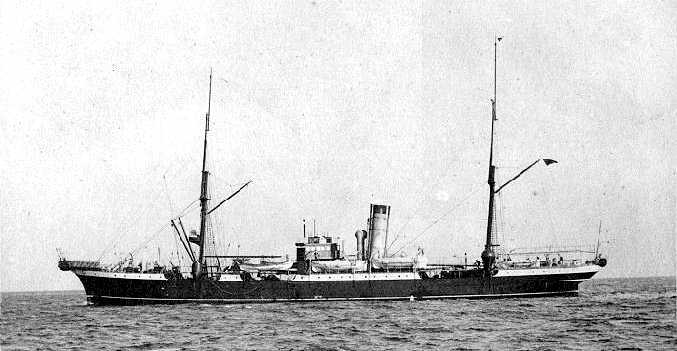
The CS Mackay-Bennett
Credit: Public Domain
On April 22, 1912, Colonel Astor’s body was recovered from the North Atlantic by the crew of the CS Mackay-Bennett, the first body recovery ship. It was Body No. 124 and he was described as being found “erect” in the ocean which was noted since many of the bodies were reclined backwards. Electrician Gerald Ross who assisted with the recovery said Colonel Astor’s arms were extended upwards. His face was swollen with one jaw injured. Ross and undertaker Jon Snow both mentioned that his gold watch was dangling from his pocket when he was recovered. It stopped at 3:20, which indicated that it continued working for some time after he jumped into the ocean. Around his waist was a belt with a gold buckle that was a family heirloom and in his pockets were $2,440 as well as money in different amounts in other currencies. His body was embalmed and placed in a coffin for transportation back to Halifax. Word was not sent to the family for several days, however. Vincent had offered $10,000 as a reward for the recovery of his father’s body, something the crew would be owed.
On April 24, Dr. Kimball gave an update on Madeleine’s condition to the press. He reported that she was suffering from physical and nervous shock, but was improving day by day. The following day, Captain Roberts (the skipper of the Astor yacht Normahaul) who was representing the Astor family arrived in Halifax awaiting word on whether Colonel Astor had been found.
On April 25, Captain Roberts relayed the report that Colonel Astor’s body was found. In light of that news, Vincent spoke to reporters telling them that any accounts purported to be from his step-mother were false. He relayed how his father told her to get dressed and they went on deck where he placed her in a lifeboat. He went on to say how he hadn’t asked questions about what happened further due to her fragile condition. Vincent further stated that he had no intentions of going to Halifax to retrieve his father’s body, leaving that grim task in Captain Roberts’ capable hands. However, Vincent changed his mind. Vincent arrived in Halifax accompanied by legal representative Biddle and butler Thomas Hade arrived in Halifax on April 29 in his father’s private railway car, Oceanic. In the meantime, speculation only increased about the will which had not been read. There were several false versions of it reported at the time which W.A. Dobbyns denied them as being true. The reporters even attempted to press William H. Force for details about the will, something he denied any knowledge of.
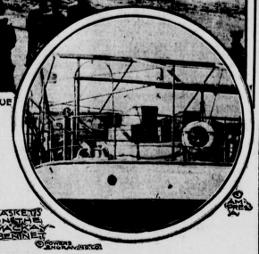
Coffins seen on the deck of the CS Mackay-Bennett
Credit: The Evening World/Library of Congress
On April 30, the Mackay-Bennett arrived in Halifax. It was a somber occasion marked by church bells and coffins stacked high on the docks. When the Mackay-Bennett docked, the crew began disassembling a pyramid of coffins stacked on the deck and bringing them one by one to a row of hearses waiting on land.
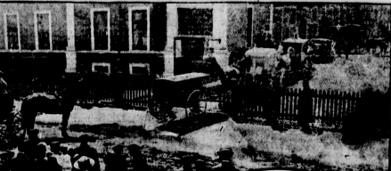
Horse-drawn hearses carrying coffins of the Titanic victims.
The Evening World/Library of Congress
Colonel Astor’s coffin was brought to the Jon Snow morgue where Captain Roberts, Biddle, and Vincent went in to identify and retrieve his body on May 1st. Captain Roberts described the body as only slightly discolored by the water and his features unharmed. True to his word, Vincent paid the $10,000 to the crew of the Mackay-Bennett as a reward for finding his father’s body. The crew pooled their share of the money and set some of it aside for burying one of the first Titanic victims they had recovered, a baby boy. He was not identified, but had touched the hearts of the crew. The crew were so touched by the sight of him, they created a pact that if the boy was not identified and claimed, they would take care of the funeral arrangements. The crew kept their word using Vincent’s reward money and gave him a proper funeral, burying him with the other victims in Halifax. The boy was known as the “Unknown Child” until DNA tests finally revealed his identity as 3rd class passenger Sidney Goodwin in 2006. Colonel Astor’s body was placed on the Oceanic for his final trip to his home of Rhinebeck.
The Funeral of John Jacob Astor IV
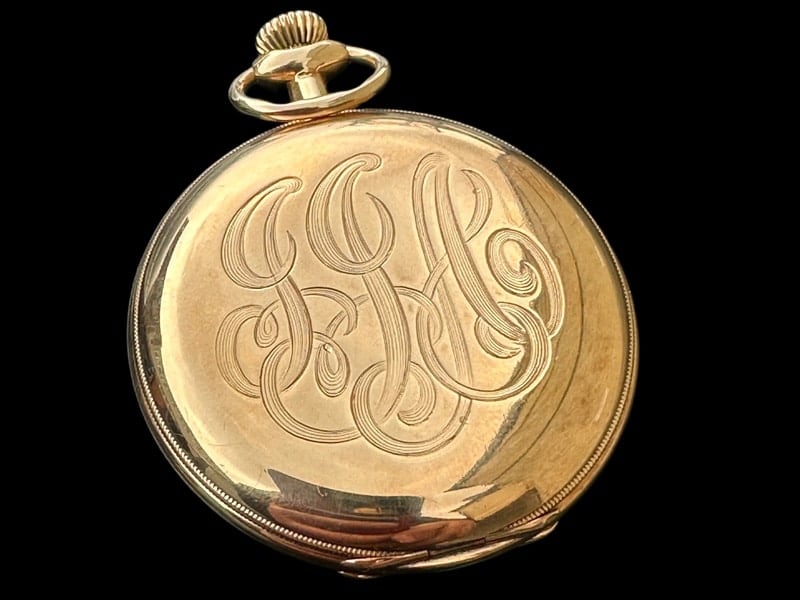
Colonel Astor's pocket watch which was found on his body and returned to his family.
Credit: Henry Aldridge & Sons Ltd.
On May 3, the Oceanic bearing Colonel Astor’s body arrived at the Ferncliff Dock, which was a small train station in Rhinebeck on his estate. Colonel Astor’s closest family members and friends were there to greet the train including his widow. Madeleine was accompanied by her sister Katherine who rarely left her side since she got to New York and her parents. The box containing his coffin was picked up by some of Colonel Astor’s employees and brought to the undertaker’s wagon. The funeral was held on May 4 in the Church of the Messiah in Rhinebeck. Colonel Astor had served as a churchwarden at the church for 16 years and was heavily involved in its day to day operations and footed the bill of repairs that needed to be made, so it was a fitting place to hold his funeral. Flags were at half mast all over Rhinebeck in honor of their late benefactor.
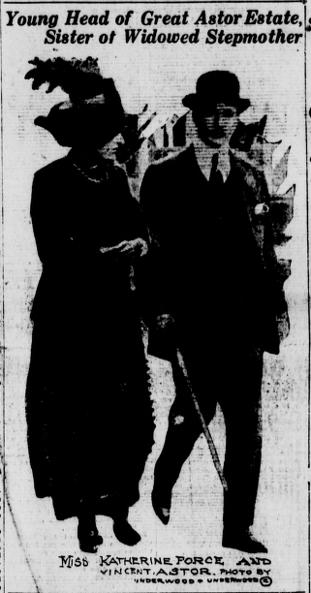
Vincent Astor and Katherine Force
The Evening World/Library of Congress
The service was conducted by Rev. Ernest Saunders, rector of the church, assisted by the Rev. Dr. William T. Manning, of Trinity Church, and the Rev. Dr. Ernest M. Stires, of St. Thomas’s Church, of New York City. That morning, a special train from New York City brought multiple friends and associates of Colonel Astor. Missing from the funeral was his first wife Ava who elected to stay in her room at the Ritz-Carlton despite being invited by both her children to join them. She did send flowers which consisted of a wreath of roses and orchids tied together by a long purple ribbon with a card saying, “Mrs. John Astor.” However, it arrived after the services started and the messenger was not allowed entry and so the flowers were left on the door of the chapel. Not more than 100 people could fit in the little chapel and it was full. Around Colonel Astor’s heavy oak casket were flowers including a spray of red roses given by the Prince of Wales. Vincent, Muriel, Madeleine, her sister Katherine, her mother and father, and Colonel Astor’s sister Caroline came with the casket. The song Dead March from “Saul” by Handel played until the casket entered the sanctuary at which time the organist switched to “Hark! Hark! My Soul.” After some preaching by the rectors, a choir of about 30 boys sang multiple hymns before the congregation was dismissed. The service lasted less than an hour.
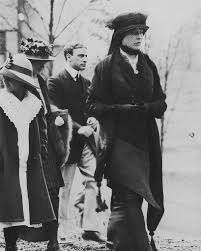
Madeleine attending her husband's funeral.
Credit: The Providence Journal
The casket was then placed on a train and brought to New York where he was brought to his final resting place, the cemetery of Trinity Church. The church was a historic location where many of the Astor men before him were buried as well as a number of people of note in American history. After a short committal service by Rev. Saunders, Colonel Astor was placed in a niche above his father’s body and next to his mother’s body. The service for Colonel Astor at Trinity Church was done the following day, Sunday, read by Dr. Manning. He incorporated lessons from Colonel Astor’s life in his sermon.
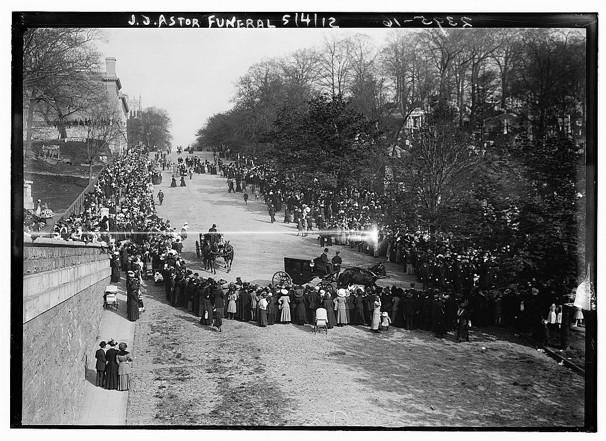
The well-attended funeral of John Jacob Astor IV
Credit: Trinity Church Archives
As is tradition with the Astor family, the will was not read until after his funeral. The family and relevant associates gathered at Rhinebeck for a reading of the will. Madeleine had use of the townhouse and a trust fund of $5,000,000 until her death or remarriage. In addition, she received $10,000 outright along with livestock and automobiles. For an expected heir, a $3,000,000 trust fund would be given to that heir once he/she turned 21. Muriel also received a trust fund of $5,000,000 which would be received when she turned 21. Money of different amounts were paid to various people who meant a lot to Colonel Astor. The bulk of the Astor estate and fortune went to William Vincent Astor. Since Madeleine, Vincent, and Muriel were under 21, they each had to have legal guardians. The trustees were James Roosevelt Roosevelt, Nicholas Biddle, Douglas Robinson, and Vincent Astor.
Around the time of Astor’s funeral, his late valet Victor Robins’ widow Louisa was filing a lawsuit for $50,000 against the White Star Line. For the suit, lawyers wanted to depose high profile survivors of the Titanic to testify. Louisa wanted to make sure her and their son George were taken care of since Victor and his source of income were lost in the disaster. She did later receive a payout from the White Star Line, though the amount is unknown. Victor’s body, if recovered was never identified.
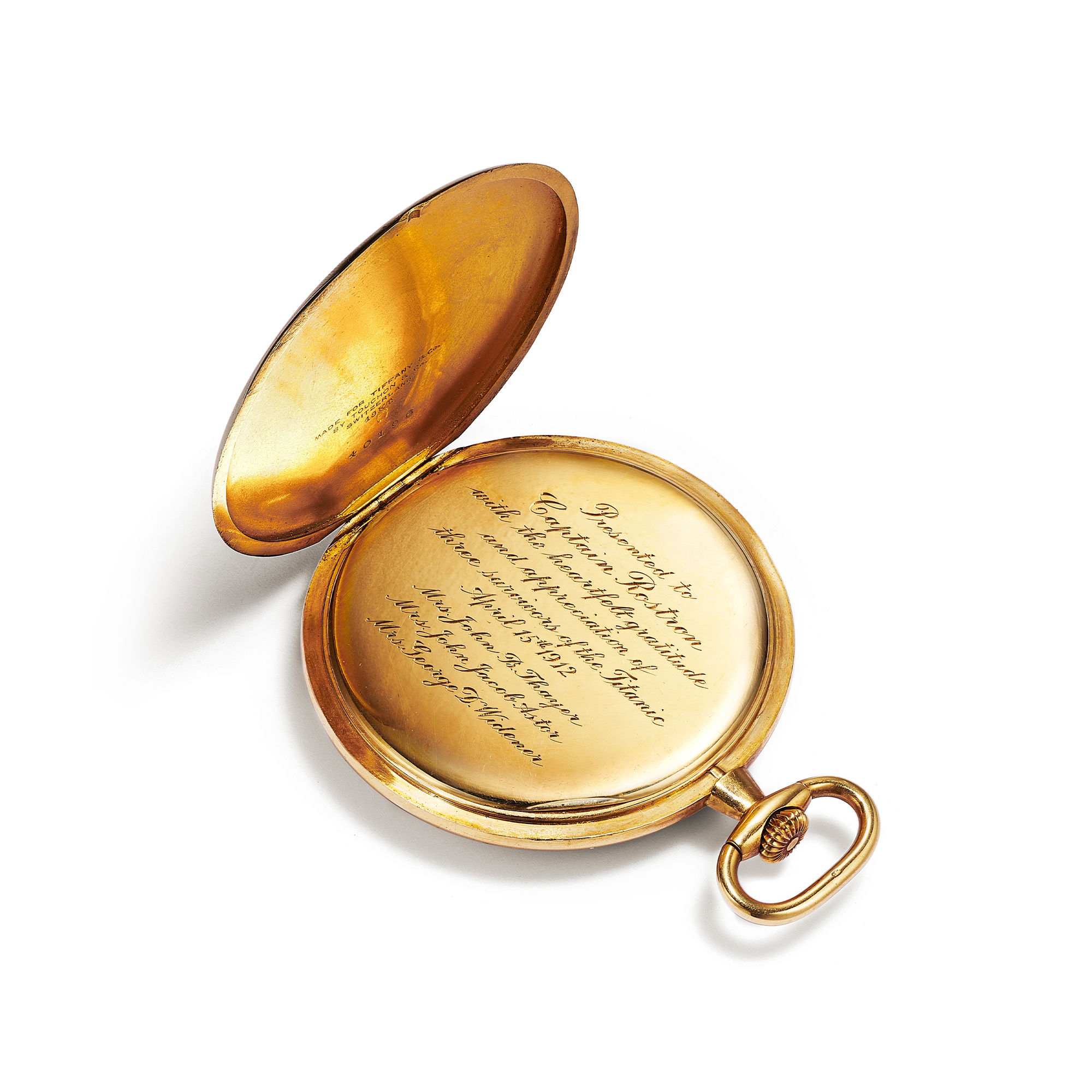
The watch gifted to Captain Rostron by Mrs. Thayer, Mrs. Astor, and Mrs. Widener.
Credit: Tiffany & Co.
On May 31, Madeleine hosted a luncheon in which she thanked Captain Rostron and Dr. McGee of the Carpathia for their rescue and care. Also invited to this luncheon were fellow survivors Marian Thayer and Florence Cummings, and her mother. Mrs. Eleanor Widener, who also survived the disaster, was invited and wanted to attend. However, she could not due to illness. Rostron and McGee arrived with some excitement because when the driver rounded a corner in front of the house, he turned so fast, one of the rear wheels flew off the car and went rolling to the side of the street. The driver briefly lost control, but regained it enough to bring them in front of the mansion. At this luncheon, Madeleine and Marian presented Rostron with a 18-carat Tiffany gold watch as a thank you gift. On the inside it was inscribed:
Presented to Captain Rostron with the heartfelt gratitude and appreciation of three survivors of the Titanic
April 15, 1912
Mrs. John B. Thayer
Mrs. John Jacob Astor
Mrs. George D. Widener
Epilogue
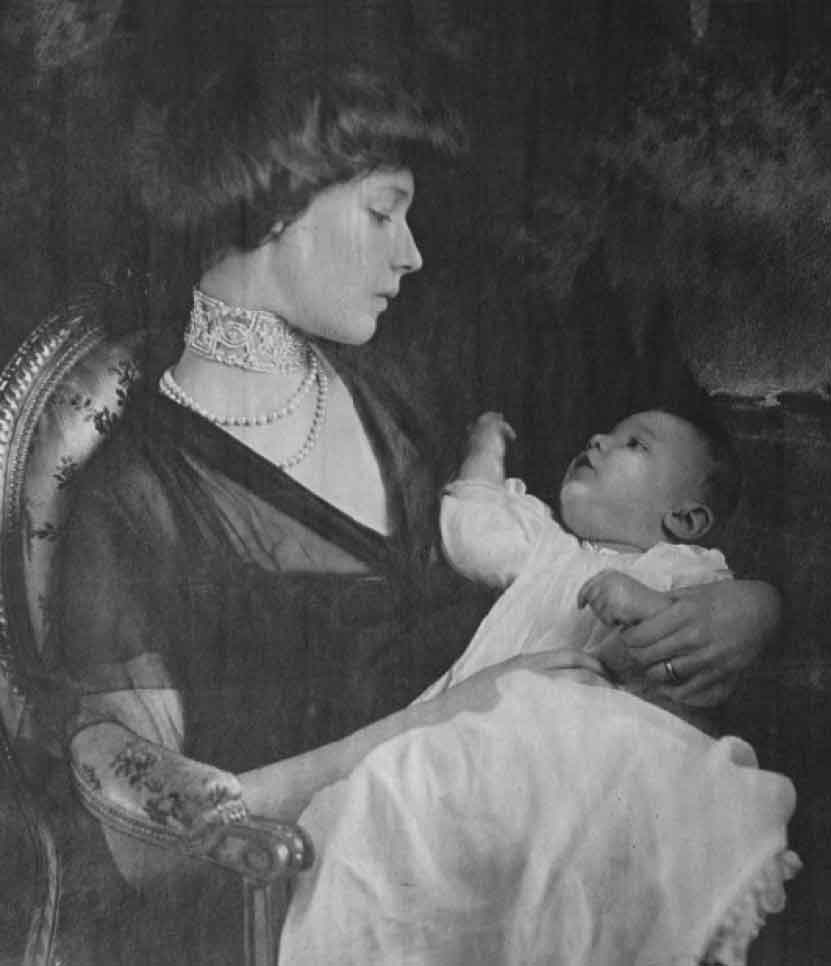
Madeleine Astor and baby John Jacob Astor VI
Credit: New York Tribune
Madeleine gave birth to a son on August 14th, 1912 at 8:15 AM weighing 7 lbs, ¾ ounces. She named him John Jacob Astor VI. She was unable to call him John Jacob Astor V due to her late husband’s cousin William Waldorf Astor using the name for his 4th son. The press were obsessed with him, dubbing him the “Titanic Baby.” In accordance with Colonel Astor’s will, he was entitled to a trust of $3,000,000 which would become available to him when he turned 21. He was loved by his mother. However, his step-brother had a hard time accepting him. Vincent and Astor VI never had a warm or close relationship. However, despite Vincent’s personal feelings, he did not contest the will in probate court to prevent his much younger step-brother from having his share of the inheritance.
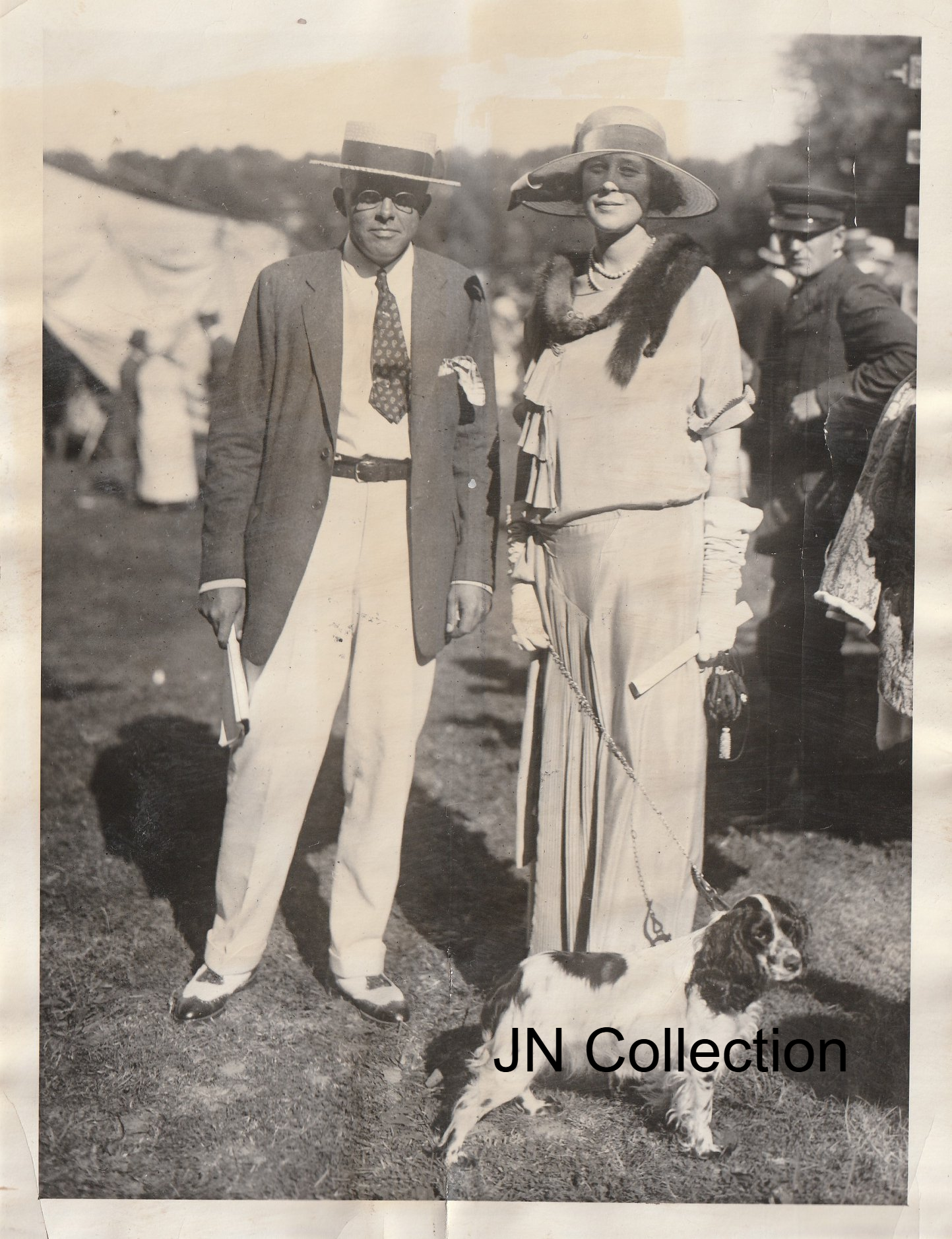
William K. Dick and Madeleine
Author's Collection
Madeleine could have lived the rest of her life in comfort in her late husband’s Fifth Avenue house. However, that did not last. There is speculation about whether she remarried for love or because of the awkward cold relationship between Madeleine and Vincent. She married a former childhood friend and wealthy businessman named William K. Dick on June 22, 1916 with her son in attendance in Bar Harbor, Maine. Upon marrying him, she relinquished any inheritance she had received from Colonel Astor to Vincent. They had two sons (William and John) and divorced in 1933 in Reno, Nevada (which was known at that time for its lenient residency laws for a quick divorce).
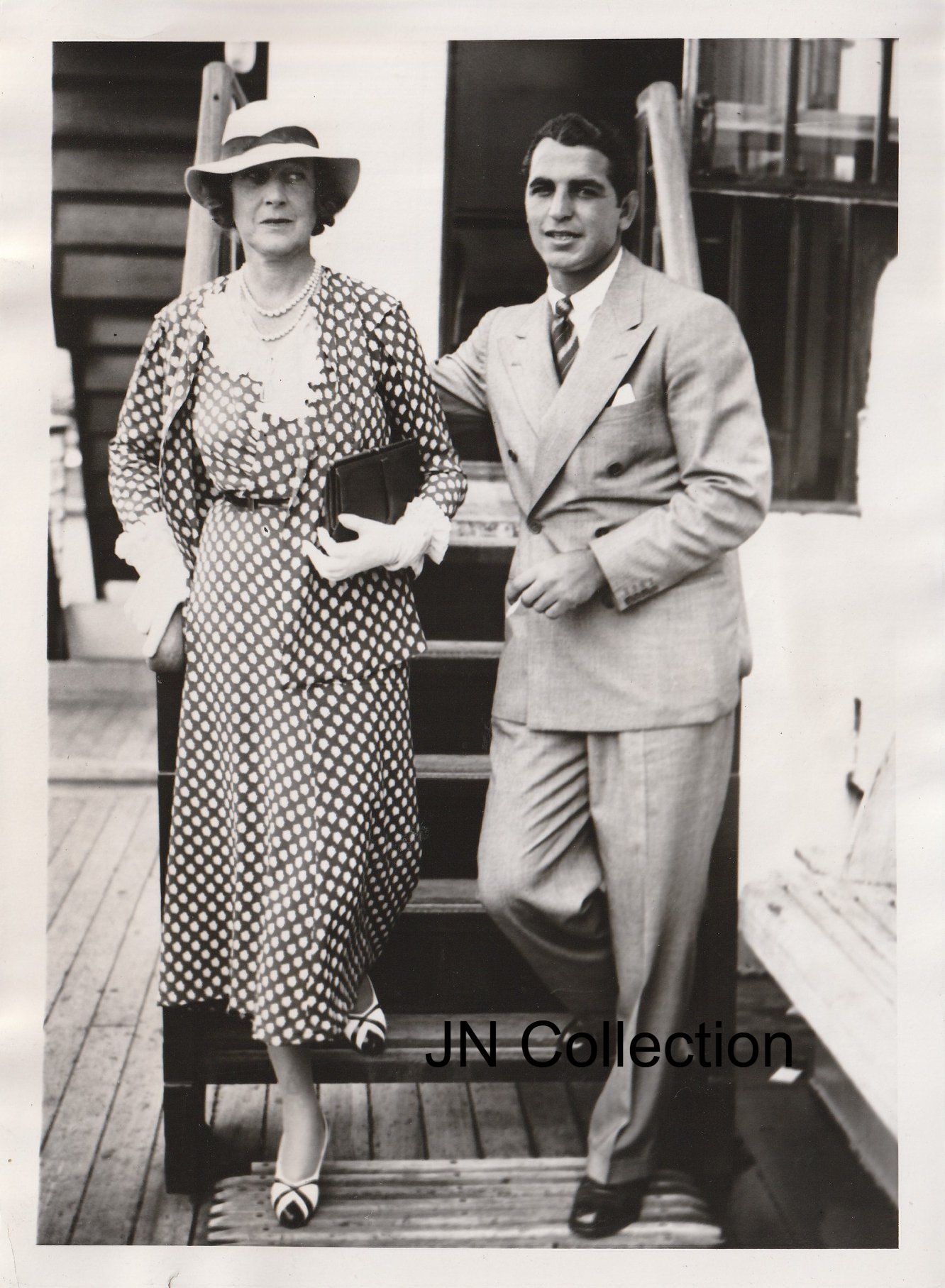
Madeleine with Enzo Fiermonte
Author's Collection
Four months afterwards, she married Italian boxer Enzo Fiermonte who was only 4 years older than her first son and had left his first wife for Madeleine. The marriage lasted until 1938 when Madeleine divorced him citing “extreme cruelty.” He was reportedly abusive towards her and had affairs on her. She lost her New York residence the following year which started from a coal furnace shortly after being robbed on a train of her jewelry.
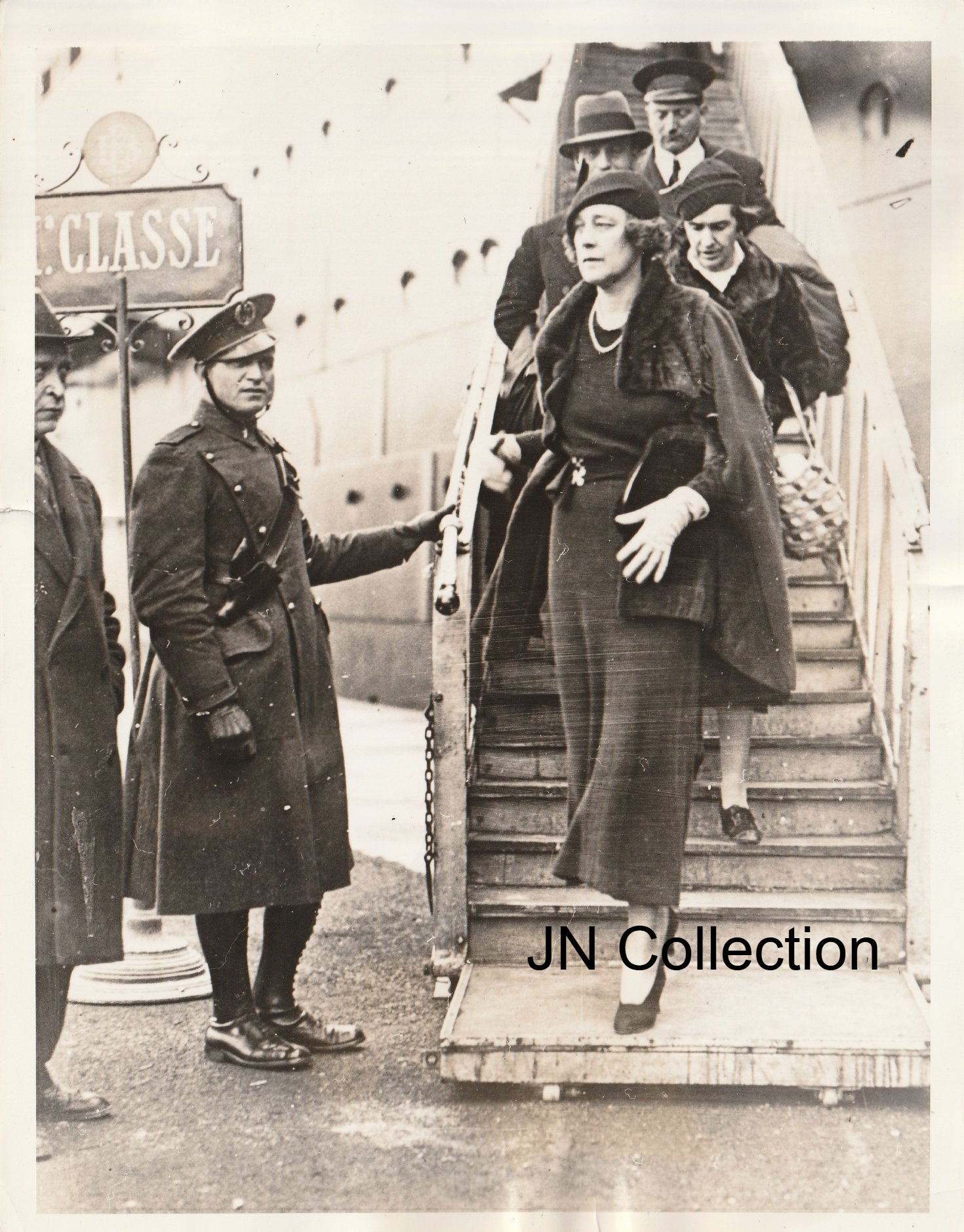
Madeleine disembarking from the SS Roma.
Author's Collection
Thankfully, her jewelry was recovered. Madeleine died in her Palm Beach house on March 27, 1940 at the age of 47. The cause of death was cited as a heart ailment/cardiovascular disease. She left her estate to be divided between her three biological sons and was interred in New York in Trinity Church Cemetery not far from her 1st husband.
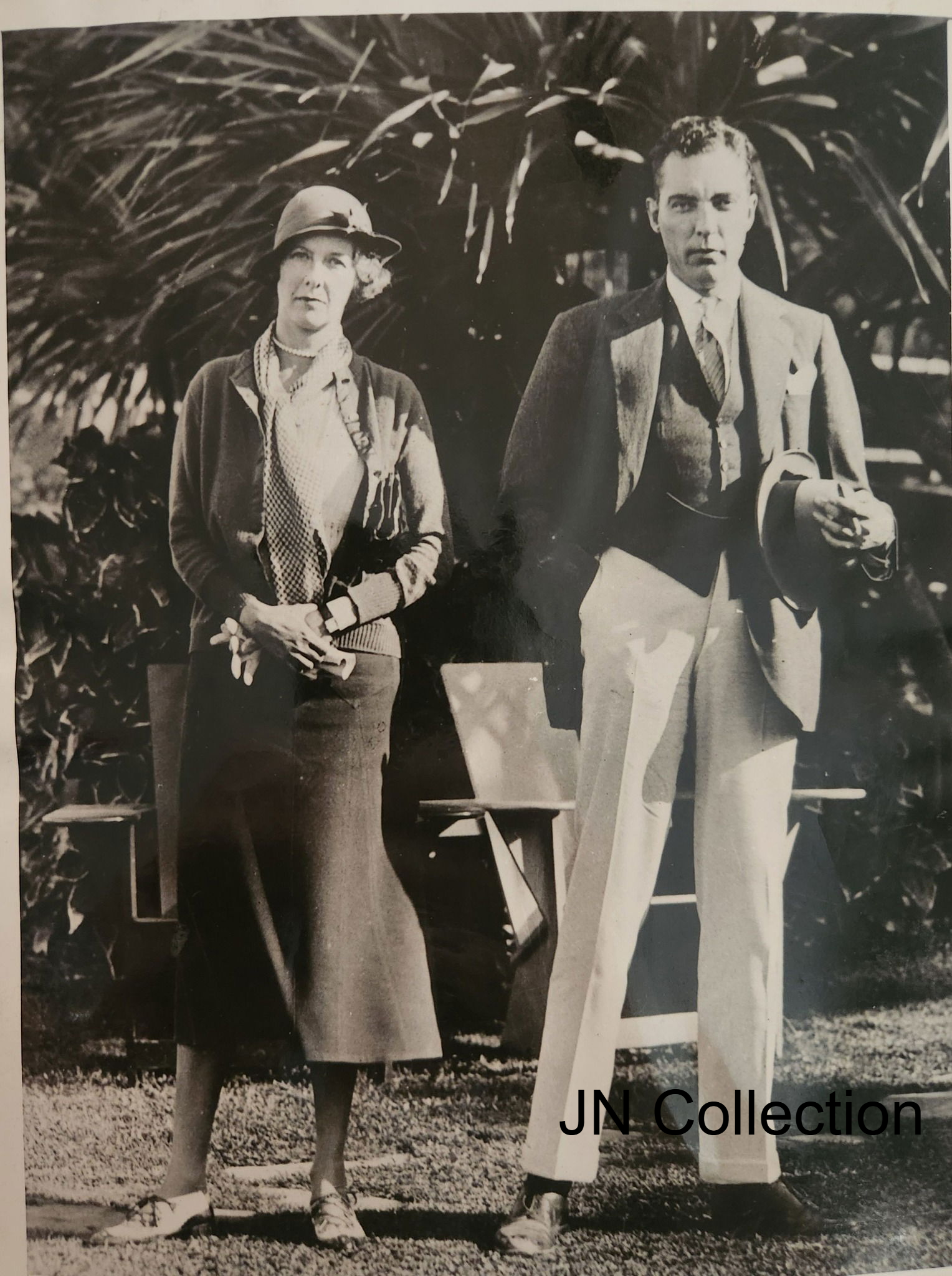
Vincent Astor and his 1st wife Helen Huntington
Author's Collection
Vincent and Muriel continued their lives, though their father’s memory was close to their hearts. Muriel was married and divorced 4 times with her first marriage being to a member of Russian nobility. She was a patron of the arts including the ballet. She died of a stroke in 1956. Vincent inherited the pocket watch his father was wearing when he died. He had it restored to working order and wore it on his person all his life. When he took on the mantle of “head of the Astor family,” he reached out to his old friend and cousin Franklin Delano Roosevelt to help him with legal issues. This turned into a life-long friendship that spanned the rest of Vincent’s life. He served in the US Naval Reserves, contributed to scientific expeditions, and was a spy during WWII. He was married three times with his last marriage being to socialite Brooke Russell. He died in 1959.
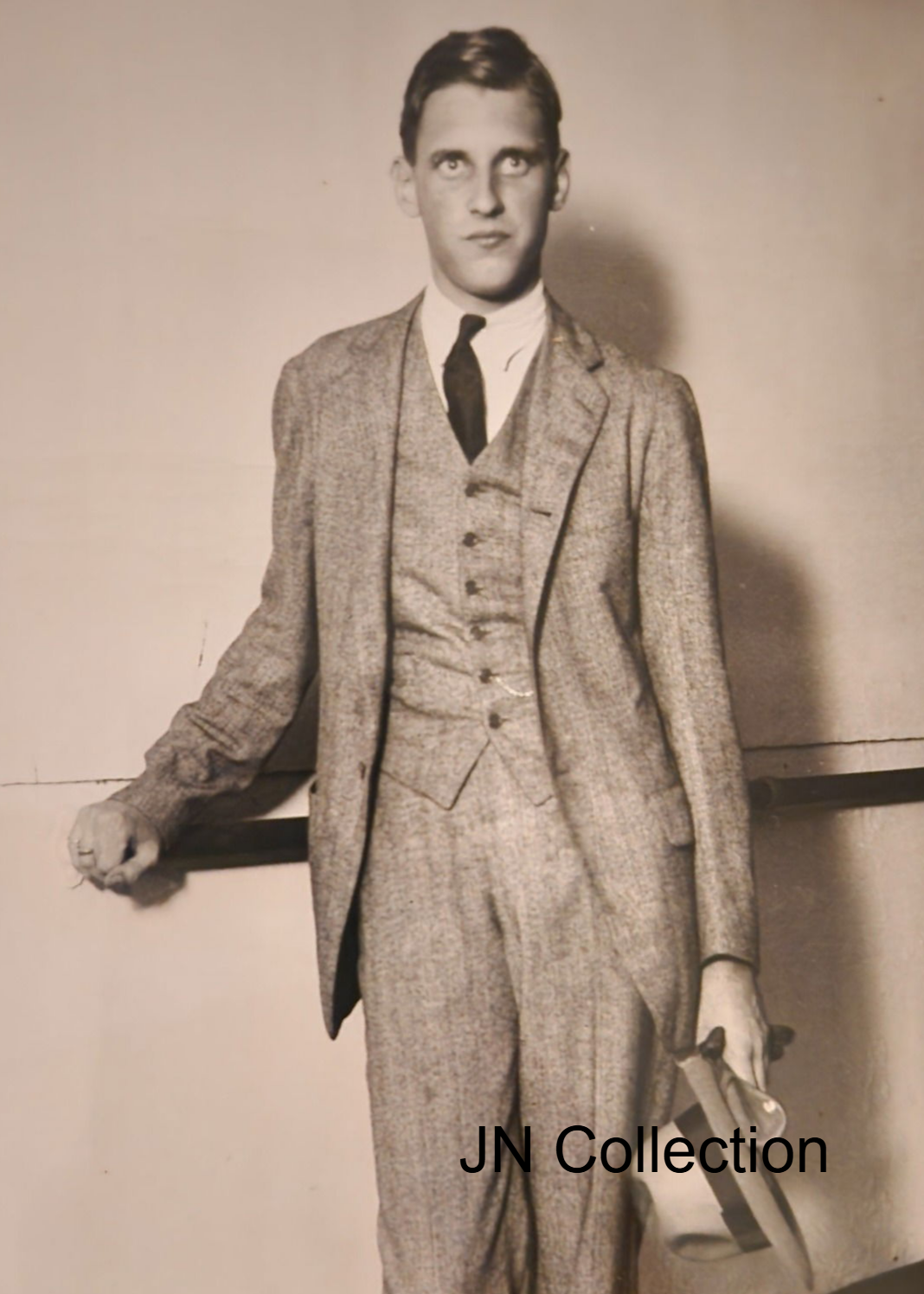
John Jacob Astor VI on board the RMS Aquitania
Author's Collection
After Vincent died, John Jacob “Jakey” Astor VI sued Brooke, believing that he was owed part of the inheritance and accusing her of keeping him from being fully competent by allowing his alcoholism. They settled for $250,000. Jakey had 4 marriages and multiple engagements with 2 children. He died in 1992 and was interred with the Astor family in Trinity Church Cemetery near the father he never met and his mother. At long last, 90 years after the Titanic sank, they were all together in death.
Resources:
New York Times August 11, 1911
New York Times September 10, 1911
The Times Dispatch April 16, 1912
The Toledo News-Bee April 16, 1912
The US Senate Inquiry Day 11
Portland Oregonian April 27, 1912
The New York Tribune April 20, 1912 p. 4
Detroit Times April 19, 1912
The Boston Herald March 10, 1910
The Globe-Democrat April 19, 1912
The Times Dispatch April 19, 1912 p. 7
Fort Wayne News April 19, 1912
The Evening World April 20, 1912 p. 6
The Washington Post April 22, 1912
New York Tribune April 20, 1912 p. 4
New York Times April 22, 1912
The Evening World April 24, 1912
The Evening World April 26, 1912 p. 1 and 6
New York Tribune April 29, 1912 p. 3
The Evening World May 2, 1912
New York Tribune May 5, 1912
New York Tribune May 7, 1912 p. 1 and 2
New York Tribune May 14, 1912 p. 3
New York Tribune June 1, 1912 p. 7
New York Times August 15, 1912
New York Times June 23, 1916
New York Times December 5, 1939
Cumberland County Historical Society
The Evening World April 22, 1912
“The Truth about the Titanic” by Archibald Gracie IV (1913)
Behe, G. (2012), On Board RMS Titanic: Memories of a Maiden Voyage, The History Press
Leyton, J. Kent. Fitch, Tad. Wormstedt, B. (2013), On A Sea Of Glass, Amberley Publishing
Jessop, V. (1997), Titanic Survivor, Sheridan House Inc.Behe, G. (2024), The Triumvirate, The History Press
Behe, G. (2015), Voices From The Carpathia: Rescuing RMS Titanic, The History Press
Barratt, N. (2010), Lost Voices from the Titanic, St. Martin's Press
Grant, R. (2014), The House That Jack Built, Beyond The St. Regis Magazine, https://magazine.stregis.com/the-house-that-jack-built/
Encyclopedia Titanica (2017) John Jacob Astor (ref: #11, last updated: 25th September 2017, accessed 27th December 2025 21:41:41 PM)URL : https://www.encyclopedia-titanica.org/titanic-victim/john-jacob-astor.html
Encyclopedia Titanica (2021) Madeleine Talmage Astor (ref: #12, last updated: 20th October 2021, accessed 24th December 2025 14:36:59 PM)URL : https://www.encyclopedia-titanica.org/titanic-survivor/madeleine-talmage-astor.html
Poirer, M. (2021), John Jacob Astor’s Fatal Mistake, Encyclopedia-Titanica, https://www.encyclopedia-titanica.org/john-jacob-astors-fatal-mistake.html
Titanic: Honor and Glory, (2025, August 26), Titanic Dogs Part I: The Canine Passengers. [Video], YouTube. https://www.youtube.com/watch?v=UA5SoQIig8k&t=296s